
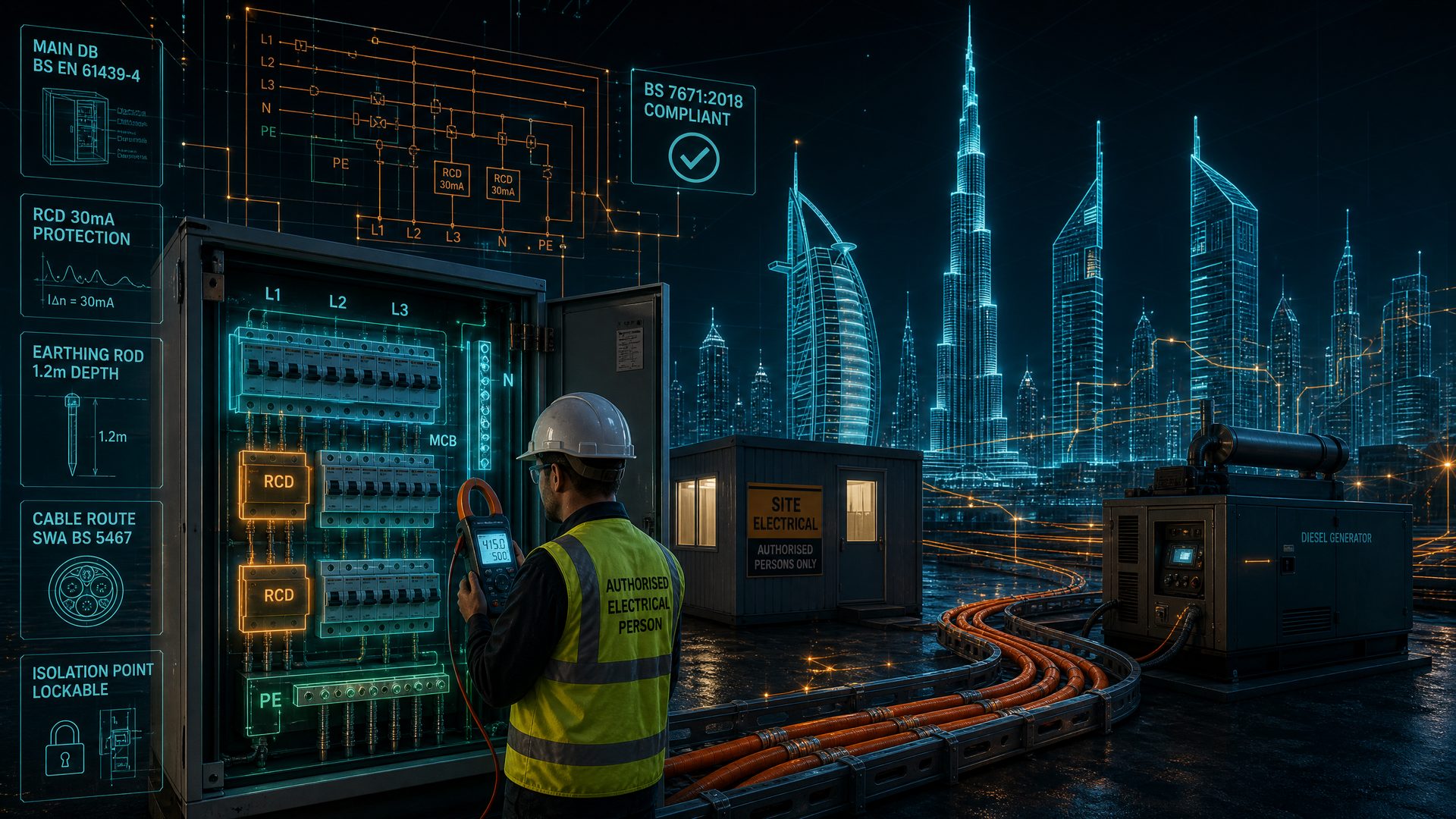
UAE Site Electrical Safety
Everything a UAE construction site needs to keep temporary power safe and compliant — earthing, isolation and bleeding, distribution boards, RCDs, breakers and LCBs, generators, cabling, and site office, welfare, water cooler, pump and bathroom supplies. Every requirement is referenced to the authority or standard that sets it.
- 10
- Compliance areas
- 7
- Authority profiles
- 98
- Checklist items
- 91
- Critical items
Compliance areas
Earthing system design, earth electrode requirements, protective bonding, equipotential bonding, and generator earthing for UAE construction sites.
Safe isolation procedures, LOTO (Lockout/Tagout), power bleeding, capacitor discharge, and permit-to-work requirements for UAE construction sites.
Temporary and permanent distribution board standards, BS 4363 / BS EN 61439-4 requirements, DB construction, labelling, and inspection for UAE construction sites.
RCD types, trip current ratings, installation requirements, and testing obligations for UAE construction sites, site offices, and welfare facilities.
MCB, MCCB, LCB, and fuse selection, breaking capacity, coordination, and installation requirements for UAE construction site distribution systems.
Generator installation, earthing, fuel storage, ventilation, noise, transfer switching, and DEWA/ADDC connection requirements for UAE construction sites.
Cable selection, derating, routing, protection, and colour coding requirements for UAE construction site temporary and permanent wiring.
Electrical requirements for temporary site offices, welfare facilities, canteens, drying rooms, and accommodation units on UAE construction sites.
Electrical safety for drinking water coolers, water transfer and booster pumps, sewage/holding-tank pumps, water heaters and site toilet/ablution blocks — the wet-area equipment present on virtually every UAE construction site.
Initial verification, periodic inspection, and testing requirements for UAE construction site electrical installations — including insulation resistance, continuity, and RCD testing.
Who regulates what
Ministry of Human Resources & Emiratisation / UAE Cabinet
No single federal electrical code for construction sites. All emirates follow their own authority regulations built on IEC 60364 and BS 7671 principles. ADOSH-SF CoP 15.0 applies federally for OSH purposes.
Abu Dhabi Department of Energy (DoE) / ADDC / ADOSH-SF (ADPHC)
Abu Dhabi's DoE EWR 2020 is based on IEC 60364 and governs all low-voltage electrical installations. ADDC (Abu Dhabi Distribution Company) conducts inspections and energisation approvals. ADOSH-SF CoP 15.0 covers occupational electrical safety on construction sites. Temporary installations are covered under Section 9.6 of EWR 2020.
Dubai Electricity and Water Authority (DEWA) / Dubai Municipality
Dubai follows the Dubai Building Code (2021) which supersedes the DEWA 2017 Regulations. General assemblies for distribution of electricity on construction sites must conform to BS 4363 and BS EN 61439. DEWA approves temporary power connections for construction purposes. The Dubai Municipality Code of Construction Safety Practice covers site electrical safety obligations.
Sharjah Electricity, Water & Gas Authority (SEWA) / OSHJ (SPSA)
Sharjah follows federal MoHRE standards supplemented by SEWA connection requirements. OSHJ (Occupational Safety and Health in Sharjah) enforces site electrical safety under the ADOSH-SF framework adapted for Sharjah. All installations must comply with the UAE Fire and Life Safety Code.
RAK Electricity / RAKEZ / Etihad Water and Electricity (EtihadWE)
RAK follows federal MoHRE and ADOSH-SF standards. EtihadWE (formerly FEWA) provides power supply and connection approvals for the northern emirates including RAK. RAKEZ industrial zones have additional electrical safety requirements for managed worker accommodation.
Etihad Water and Electricity (EtihadWE) / Local Municipalities
Ajman, Fujairah, and Umm Al Quwain follow federal MoHRE standards and EtihadWE connection requirements. Local municipality building departments oversee electrical installation approvals. All installations must comply with IEC 60364 / BS 7671 principles as adopted in the UAE.
Trakhees (JAFZA/Dubai Free Zones) / RAKEZ / KIZAD / Other FZAs
Each free zone authority may impose supplementary electrical requirements. Trakhees enforces the UAE Fire and Life Safety Code and Dubai Building Code for JAFZA and other Dubai free zones. KIZAD (Abu Dhabi) follows DoE EWR 2020. RAKEZ follows its own managed industrial zone standards.
Before you energise anything
This hub is reference material compiled from published UAE authority documents and British/IEC standards. It does not replace a competent person's design, inspection and test certification, or the connection approval of your local supply authority (DoE/AADC/ADDC, DEWA, SEWA, EtihadWE or the relevant free-zone authority).
Frequently asked questions
Common questions about temporary electrical supply, RCDs, distribution boards and generators on UAE construction sites.
What rules govern temporary electrical supply on a UAE construction site?
Temporary site power is governed by the supply authority in your emirate plus the applicable standards. In Abu Dhabi that is the DoE Electricity Wiring Regulations 2020 and ADOSH-SF Code of Practice 15.0; in Dubai it is DEWA regulations with the Dubai Building Code 2021; Sharjah applies SEWA rules alongside OSHJ. Across all emirates the underlying technical standards are BS 7671/IEC 60364 for installation design, BS 4363 for site distribution assemblies and BS EN 61439-4 for the assemblies themselves.
What RCD rating is required for construction site socket outlets in the UAE?
Socket outlets used for portable equipment must be protected by a 30 mA residual current device with a maximum disconnection time of 40 ms at 5x rated residual current. Larger fixed supplies and distribution boards typically use 100–300 mA time-delayed RCDs for fire protection and discrimination. RCDs must be trip-tested with the test button monthly and by instrument at each periodic inspection, and the results recorded.
How often should site distribution boards be inspected and tested?
Visual inspection of DBs, leads and enclosures should be weekly, with formal inspection and test by a competent person every three months for construction installations — more frequently in harsh or high-humidity conditions. Portable equipment and extension leads are inspected before each use and formally tested every three months. Every result belongs in an inspection and test register with the tester's name, instrument serial number and calibration date.
What earthing arrangement should be used for a construction site?
Site supplies are normally TN-S or TT depending on the supply authority's requirement. Earth electrode resistance must be measured and recorded, main and supplementary bonding must be continuous to all exposed and extraneous conductive parts, and generator neutral earthing must be arranged so a single earth reference exists. Earth continuity readings should be re-verified after any board is relocated.
Do generators on site need different controls to a mains supply?
Yes. Generators require a defined neutral–earth reference, an earth electrode with a measured resistance value, RCD protection on all outgoing socket circuits, bunded fuel storage, exhaust routing away from occupied areas and welfare units, and an isolation/lock-off point identified in the permit. Parallel or synchronised sets need documented protection settings from a competent electrical engineer.
Does this apply to site offices and welfare areas as well?
It does. Site offices, canteens, prayer rooms, ablution blocks and accommodation cabins are supplied from the same temporary installation and carry the added risk of water and continuous occupancy. They need RCD-protected final circuits, IP-rated fittings in wet areas, emergency lighting, clearly labelled isolation, and periodic inspection on the same register as the construction supply.
Cross-referenced modules
Temporary power feeds almost every other high-risk activity — access equipment and lighting at height, and generators or supply to plant and site vehicles.
Next step
Turn this into evidence you can hand over
Replace scattered spreadsheets and WhatsApp threads with one HSE operations system built around UAE authority expectations.
- Built around UAE authoritiesADOSH-SF, Trakhees, DM, DCD, MOIAT and ISO 45001 structures.
- Usable the same dayTemplates and registers are pre-filled with your company details.
- Evidence, not just formsEvery record carries dates, signatures and an export you can hand over.