
Article
Working at Height: The Hierarchy, the Clearance Calculation and the Rescue Nobody Plans For
Falls remain among the leading causes of fatal injury on construction sites. How the hierarchy of control, the fall clearance calculation and a pre-planned rescue arrangement work together on UAE projects.
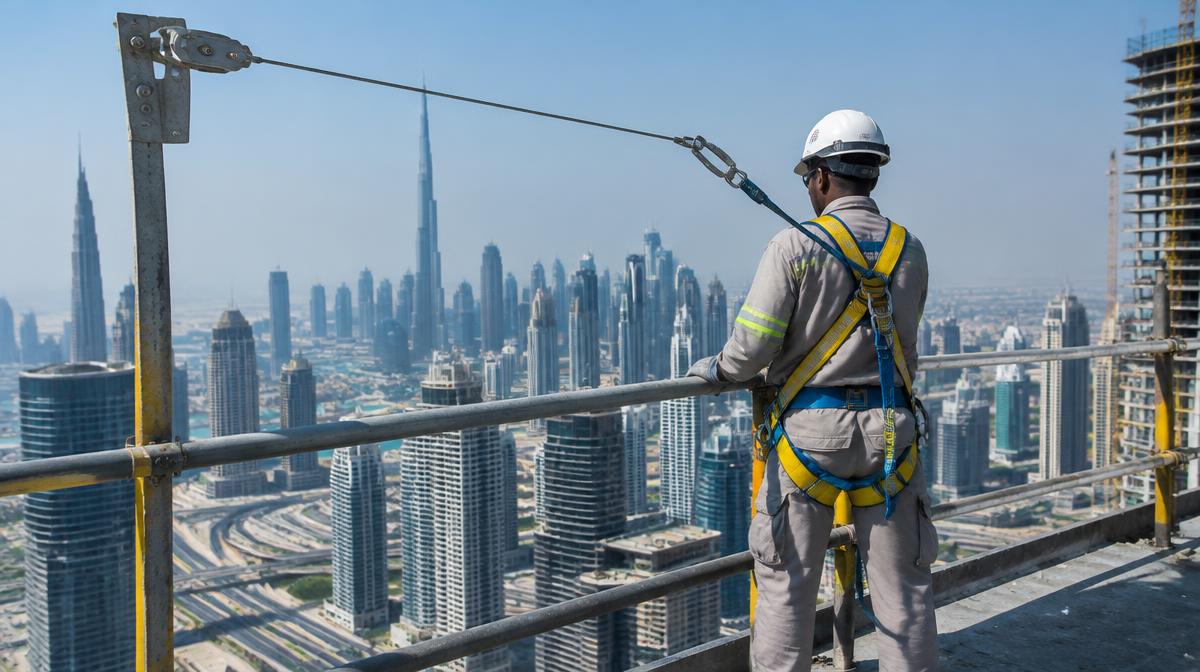
Falls from height are consistently among the leading causes of fatal injury in construction, and the reason is structural rather than personal. Work at height is designed into the way buildings are built, the protection is usually temporary, and the control that gets the most attention — the harness — is the one that does nothing until after the fall has already happened.
Getting it right means working through a sequence in the right order: remove the need to be up there, prevent the fall collectively, arrest it personally, and then answer the question almost nobody plans for — what happens in the minutes after someone is left hanging.
The hierarchy, in order, without shortcuts
1. Eliminate. Do the work from the ground or from a completed, permanent floor. Extend the tool, pre-assemble at ground level, use a camera or drone for the inspection, install the service before the ceiling goes up. Every task removed from height is a fall that cannot happen.
2. Prevent collectively. Guardrails, working platforms, edge protection, covers over openings, physical barriers. Collective protection has one enormous advantage: it works without the worker doing anything, remembering anything, or behaving correctly at the end of a long shift. It protects the trained and the untrained, the careful and the distracted, the person who was never briefed.
3. Arrest personally. A harness, lanyard and anchor. This is the last line, and it is a weaker control than it appears: it depends on selecting the right equipment, fitting it correctly, anchoring it properly, calculating the fall, and the worker being attached at the moment they fall. A harness is not protection in the same sense a guardrail is; it is a device that limits the consequence of a failure that already happened.
4. Reduce the consequence. Where work at height is unavoidable and unprotected, limit the fall distance, the exposure time and the number of people exposed.
The clearance calculation: where harnesses quietly fail
A fall arrest system needs vertical space to work, and that space is larger than most people assume. The total fall distance is the sum of:
- the length of the lanyard,
- the deceleration distance as the energy absorber extends,
- any stretch in the material,
- the height of the worker's attachment point on their body,
- and a safety margin so nothing touches below.
Add those up and a worker attached to an anchor at their feet can fall several metres before the system even begins to arrest them. On a structure with a lower level, a scaffold lift or a wall below, that arithmetic decides whether the person is caught or hits something first. Where the clearance is not enough, the system has to change: a shorter lanyard, a self-retracting device, or an anchor positioned above the worker rather than below.
Two related problems cause a large share of serious fall injuries:
- Swing fall. An anchor placed to one side rather than overhead means a fall swings like a pendulum, and the worker strikes the structure on the way. The anchor position matters as much as its strength.
- The convenient anchor. A pipe, a handrail, a cable tray or a temporary fixing that was never designed as an anchor point. Anchor points are rated, positioned and identifiable — and where none exists, one is installed before the work starts.
Equipment: the details that decide outcomes
- Full-body harness, not a belt. A belt loaded in a fall causes internal injury; a harness distributes the load and keeps the body upright.
- Double lanyards for transitions. Any method that requires the worker to detach to move between anchors needs a way to stay attached while they do it.
- Correct connection. No knots in lanyards, no improvised links, no lanyard wrapped around a structural edge where it can be cut, and no two lanyards clipped to each other.
- Inspection before every use, with periodic inspection by a competent person and records kept. Damage, wear, UV degradation, stitching, corrosion, impact indicators — and anything that has arrested a fall is removed from service, without exception.
- Fit. A loose harness that rides up in a fall causes injury even when the arrest works. Fit is a control, not a comfort preference.
Rescue: the part that is usually missing
A worker hanging in a harness after an arrested fall is not safe. Suspension in a harness restricts blood flow, and the onset of suspension trauma can be rapid — which makes the rescue arrangement a pre-planned, pre-equipped capability, not a call to the emergency services and a wait.
The plan has to answer four questions before the work starts:
- Who is suspended, and where? On a facade, inside a shaft, on a roof edge, on a platform. The rescue method follows the location.
- How does the person get down? Self-rescue first — a worker who is conscious can use relief steps or a foot loop to relieve the harness load while waiting. Then assisted descent using a device. Then lowering from the anchor. Then a technical rescue for someone unconscious or trapped.
- Who performs it, with what equipment, on site, right now? Rescue equipment that is on site, inspected and immediately available; a person trained to use it; and a realistic time to reach the casualty. A rescue capability that arrives in forty minutes is not a rescue capability for suspension trauma.
- Has it been practised? A rescue plan that has never been rehearsed with the actual equipment, on the actual structure, is an intention. Rehearse it once, and the difference between a plan and a capability becomes obvious.
And the rule that mirrors confined spaces: nobody descends to a suspended worker without their own protection and a controlled method. The colleague who climbs down on a rope to help becomes the second casualty.
Fragile surfaces, openings and ladders
- Openings are covered, secured so they cannot be moved, marked so the cover cannot be mistaken for a floor, and recorded — because the cover that gets lifted for a service run and never replaced is a classic fatality.
- Fragile surfaces — roof sheeting, skylights, rooflights, ageing panels — need a planned route, crawling boards or staging, edge protection and warning signage at every access point, not just at the first one.
- Ladders and stepladders are working platforms for short-duration, light work only, and they need to be the right class, secured, at the correct angle, with three points of contact and no working from the top steps. Most "fell from ladder" injuries are a task that should have been done from a platform.
- MEWPs carry their own discipline: harness and anchor point inside the basket, correct platform for the task, ground conditions, and no leaning out or standing on the guardrail.
Competence, permits and the brief
Work at height is a permit-controlled activity on most projects, and the permit is only as good as the brief behind it. The brief names the specific location, the specific method, the specific protection, the anchor points to be used, the rescue arrangement, and the person supervising. "Wear your harness" is not a brief; it is an assumption that everything above has already been decided.
What the evidence looks like
For the activity: the risk assessment and method statement, the work-at-height permit, the collective protection as installed and inspected, the anchor point specification and inspection, the equipment issue and inspection records, the harness and lanyard inspection regime, the rescue plan with the equipment and the people named, the training and competence records, and the briefings.
Where those exist, the site can demonstrate that the fall was prevented where it could be, arrested where it could not, and that somebody had thought about the minutes afterwards.
"Reference material, not legal advice. Requirements differ by emirate, authority and client. Fall protection equipment selection, anchor point design and rescue arrangements must be specified by competent persons for the specific location and task."
Continue with
- Working at Height Safety hub — https://sitesafetyuae.com/working-at-height
- Hierarchy and Planning — https://sitesafetyuae.com/working-at-height/hierarchy-and-planning
- Fall Arrest Systems — https://sitesafetyuae.com/working-at-height/fall-arrest-systems
- Edge Protection and Openings — https://sitesafetyuae.com/working-at-height/edge-protection-and-openings
- Rescue and Emergency Response — https://sitesafetyuae.com/working-at-height/rescue-and-emergency-response
- Fragile Surfaces and Roof Work — https://sitesafetyuae.com/working-at-height/fragile-surfaces-and-roof-work
- Working at Height checklist — https://sitesafetyuae.com/working-at-height/checklist
- Working at Height Reset: Confirm Protection Before the First Lift — https://sitesafetyuae.com/resources/monday-working-at-height-reset
Site Safety UAE builds the HSE Operations Dashboard for UAE and GCC construction projects — permits, inspections, equipment records and rescue arrangements in one place. Start free, no card required — https://sitesafetyuae.com/get-started.
Recommended next reads
- Confined Space Entry: The Rescue Arrangement Is the Part That FailsConfined space fatalities often include someone who went in to help. How UAE sites control entry with isolation, testing and an attendant, and why the rescue arrangement — not the permit — is where entries fail.Read guide
- Scaffolding Safety in the UAE: Platform Widths, Ties, Inspection and the Alteration ProblemScaffolding is one of the most strictly regulated and most frequently altered structures on a UAE site. The platform width, guardrail gap, design trigger and inspection rules that apply, and the site practices that keep a scaffold compliant.Read guide
- Excavation Safety in the UAE: Protective Systems, Surcharge and the Daily InspectionExcavation collapse gives no warning and leaves no time to rescue. How UAE projects select protective systems, control surcharge and water, inspect faces daily, and plan a realistic emergency response.Read guide
UAE HSE Legal Guide 2026
The consolidated PDF: federal and emirate-level HSE obligations, authority responsibilities and the evidence each inspection expects. Sent to your inbox.
Browse everything in the UAE HSE Compliance Hub.
For safety officers
Sign in to the safety officer portal for your daily reports, the hazards whose controls still need verifying, and the authority forms waiting on a decision.
See it in action
Site Safety UAE is a software-only platform. Watch the recorded demo to see the modules covering your project scope and authority mix.
Watch the demo