
Article
Temporary Electrical Safety: The Installation That Grows Faster Than Its Records
A site's temporary electrical installation is designed once and extended by everyone. How UAE projects keep protection, cabling, competence, isolation and testing records ahead of the growth.
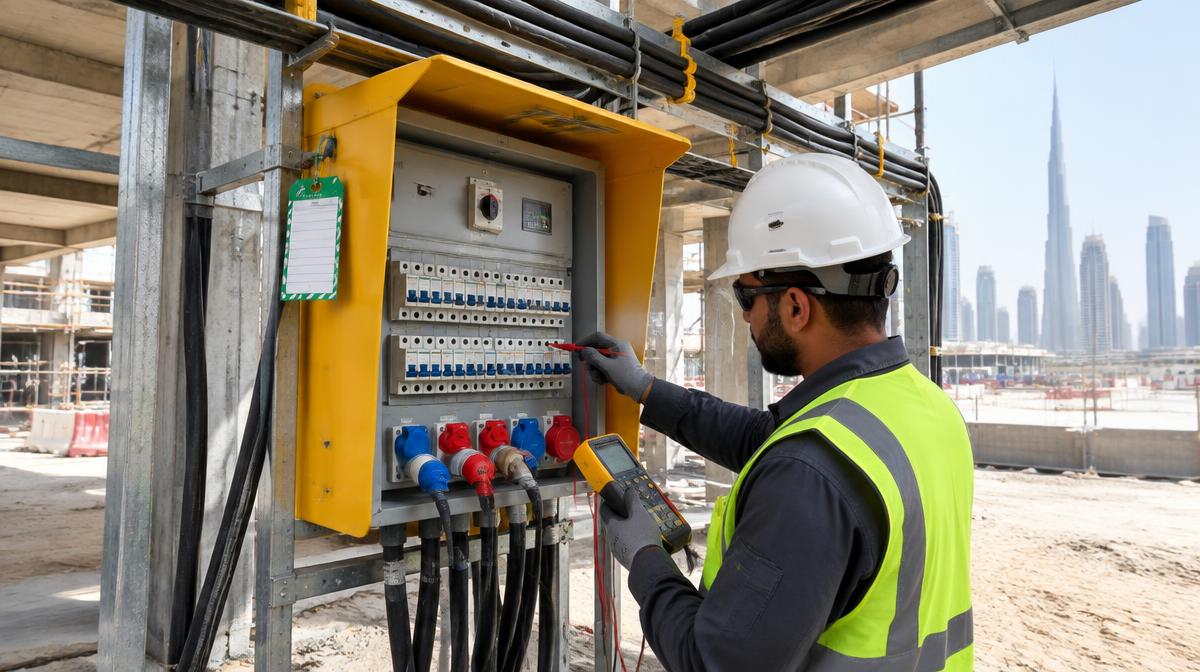
Every site's temporary electrical installation starts as a design: a supply, a distribution arrangement, protection sized for the demand, and a route for the cables. Then it grows. A tower light here, a welding set there, a sub-board for the fit-out contractor, a pump for the dewatering, a temporary supply for the site office, an extra socket for the block saw.
Each addition is small and individually justifiable. The aggregate is a system that nobody designed, that has more load than the original arrangement anticipated, and whose cables are now lying through a wash-down area, across a vehicle route, and over an edge. That is the failure pattern: not one big mistake, but a hundred small extensions and no record of any of them.
The first control is ownership
Someone has to own the temporary installation — the design, the extensions, the inspection and the records. On most sites that person exists informally (the electrician who everyone calls) but has no authority to refuse an addition. Give the role the authority: no electrical work, and no extension of the installation, by anyone other than the authorised competent electrician, and every addition recorded against the installation.
The corollary matters as much: the trades must be able to get what they need quickly and legitimately. If a legal, inspected socket is two days away, the site will produce an illegal one.
Protection and earthing
The protection arrangement is a design decision, not a shop-floor one: the supply characteristics, the protective devices, and the earth-fault protection appropriate to the installation, sized for the load that is genuinely connected — including the load that has been added since commissioning.
Two practical consequences:
- Every addition is a re-check. A new sub-board, a bigger pump or a welding set added to a circuit changes the demand on the protective device that was sized before it existed.
- The installation's documentation follows the installation. Where the site keeps the design, the test results and the extension record together, an audit takes minutes. Where it does not, the site discovers what it has only when something goes wrong.
The specifics of protection for temporary supplies are covered in the site's own guidance on temporary electrical supply and RCD requirements; the operational point here is that protection that was correct at commissioning does not stay correct by itself.
Cables in a construction environment
Most electrical injuries on sites are not caused by a design failure. They are caused by a cable that was damaged, wet, or somewhere it should not have been.
- Vehicle and plant damage. Cables routed across access routes, laydown areas or under a parked machine get crushed, cut or dragged. Routes are planned, cables are protected, and crossings are ramped or buried with the route marked.
- Water. Wash-down, tanker filling, wet trades, dewatering discharge, standing water in a sump, and the cable lying in it. Water and damaged insulation is the combination that kills. Cables are routed clear of wet areas, connectors are kept off the ground, and the installation is inspected after any flooding.
- Trailing leads used as permanent supplies. The extension lead that has been in place for four months, feeding a fixed load, across a doorway, is no longer a temporary lead — it is an unrecorded permanent circuit with no protection.
- Connectors and adaptors. Plugs hanging by the cable, connectors lying in mud, insulating tape over a damaged plug, and the multi-adaptor carrying four loads from one socket. Every one of those is a decision someone made because the correct provision was not there.
- Physical protection. Cables over edges, through doorways, along scaffold, and across openings need protection and support, not just a warning sign.
Portable tools and equipment
Tools are inspected, maintained and withdrawn from service on damage — including the tool that was dropped, the grinder with a cracked casing, and the drill whose cable has been repaired twice. The controls that hold up are a pre-use check by the user, a periodic inspection by a competent person, and a physical quarantine point so a defective tool cannot quietly return to the shelf.
Isolation, lock-off and proving dead
The most dangerous electrical work on a construction site is the work done on an installation that someone believes is dead. The discipline is short and non-negotiable:
- Isolate the supply at the correct point, and identify what else the isolation affects — particularly shared circuits and anything feeding another trade.
- Lock and tag, with the person working holding the key, and a defined procedure for removal that never involves someone else cutting a lock off.
- Prove dead with an instrument that has been proved working immediately before and after the test, at the point of work.
- Account for stored energy — capacitors, batteries, generators, UPS, PV — and for the possibility of inadvertent re-energisation from a second source.
- Return the system deliberately, with the people who are working on it told before the supply returns.
Where work near live parts cannot be avoided, it is justified, planned, controlled and authorised as its own activity — not absorbed into a normal shift.
Generators and earthing
Generators bring their own set of conditions: siting away from combustible storage and refuelling, protection of the cable run from the generator to the distribution, earthing and bonding arrangements as designed, protection against overload, and the discipline of refuelling a hot machine. The generator is part of the electrical installation and belongs on the same records.
Inspection, testing and the record
Temporary installations degrade faster than permanent ones, and the inspection regime reflects that:
- A schedule — who inspects and tests, at what interval, and what is covered (the distribution arrangement, the protective devices, the earthing, the cable routes, the equipment).
- Testing that is recorded, with the date, the result and the instrument used. A test button pressed and a person saying "it's fine" is not a record, and it is not a test.
- Inspection after any event — flooding, plant damage, a fire, a strike on a cable, or a change to the installation.
- A near-miss log that includes electrical events. A shock that did not injure anyone, an arc, a burning smell, a tripping device that keeps resetting: these are the indicators that precede a serious incident, and they are routinely not reported.
The behaviour problem
The person who receives an electric shock on a construction site is frequently not an electrician. They are the worker who moved a cable, who plugged in a damaged lead, who reached for a light fitting with wet hands, or who reset a device that had tripped for a reason.
That is why the site's electrical safety depends on three things beyond the installation itself: nobody except the authorised electrician touches the installation; everyone knows how to report a defect and expects it to be fixed; and no one resets a protective device repeatedly without it being investigated.
What the evidence looks like
For the installation: the design and authorisation record, the competence records of the electricians, the inspection and test records with dates and results, the extension history, the isolation and lock-off records, the permits for work near live parts, the equipment inspection records, and the electrical near-miss records.
Where those records exist and are current, the site can show that the installation is still the installation somebody designed — rather than a system that grew past its documentation months ago.
"Reference material, not legal advice. Requirements differ by emirate, authority and client. Electrical design, installation, testing and isolation must be carried out by competent electricians, and the protection arrangement must be designed for the installation."
Continue with
- Site Electrical Safety — https://sitesafetyuae.com/site-electrical
- Site Electrical checklist (82 points) — https://sitesafetyuae.com/site-electrical/checklist
- Temporary Electrical checklist — https://sitesafetyuae.com/site-checklists/temporary-electrical
- Temporary Electrical Installations (awareness module) — https://sitesafetyuae.com/training/temporary-electrical-installations
- Electrical Safety and LOTO (awareness module) — https://sitesafetyuae.com/training/electrical-safety-loto
- Temporary Electrical Supply: RCD Requirements in the UAE — https://sitesafetyuae.com/resources/temporary-electrical-supply-rcd-requirements-uae
- LOTO and Electrical Isolation Evidence Pack (UAE) — https://sitesafetyuae.com/resources/loto-electrical-isolation-evidence-pack-uae
- Electrical Isolation: A Field-Led Monday Check — https://sitesafetyuae.com/resources/monday-electrical-isolation-check
Site Safety UAE builds the HSE Operations Dashboard for UAE and GCC construction projects — isolation permits, inspection and test records, equipment registers and near-miss logs in one place. Start free, no card required — https://sitesafetyuae.com/get-started.
Recommended next reads
- LOTO and Electrical Isolation: 2026 Evidence Pack for UAE ContractorsWhat a lockout/tagout and electrical isolation evidence pack should contain on a UAE construction project — isolation certificates, register entries, competence, testing, permit linkage and re-energisation control.Read guide
- Temporary Works: The Load Path Nobody Owns on a UAE SiteFormwork, falsework, back-propping and excavation support fail when the load path is assumed rather than designed and checked. How UAE projects run a temporary works register, approvals and striking controls that hold up.Read guide
- Scaffolding Safety in the UAE: Platform Widths, Ties, Inspection and the Alteration ProblemScaffolding is one of the most strictly regulated and most frequently altered structures on a UAE site. The platform width, guardrail gap, design trigger and inspection rules that apply, and the site practices that keep a scaffold compliant.Read guide
UAE HSE Legal Guide 2026
The consolidated PDF: federal and emirate-level HSE obligations, authority responsibilities and the evidence each inspection expects. Sent to your inbox.
Browse everything in the UAE HSE Compliance Hub.
For safety officers
Sign in to the safety officer portal for your daily reports, the hazards whose controls still need verifying, and the authority forms waiting on a decision.
See it in action
Site Safety UAE is a software-only platform. Watch the recorded demo to see the modules covering your project scope and authority mix.
Watch the demo