
Article
Temporary Works: The Load Path Nobody Owns on a UAE Site
Formwork, falsework, back-propping and excavation support fail when the load path is assumed rather than designed and checked. How UAE projects run a temporary works register, approvals and striking controls that hold up.
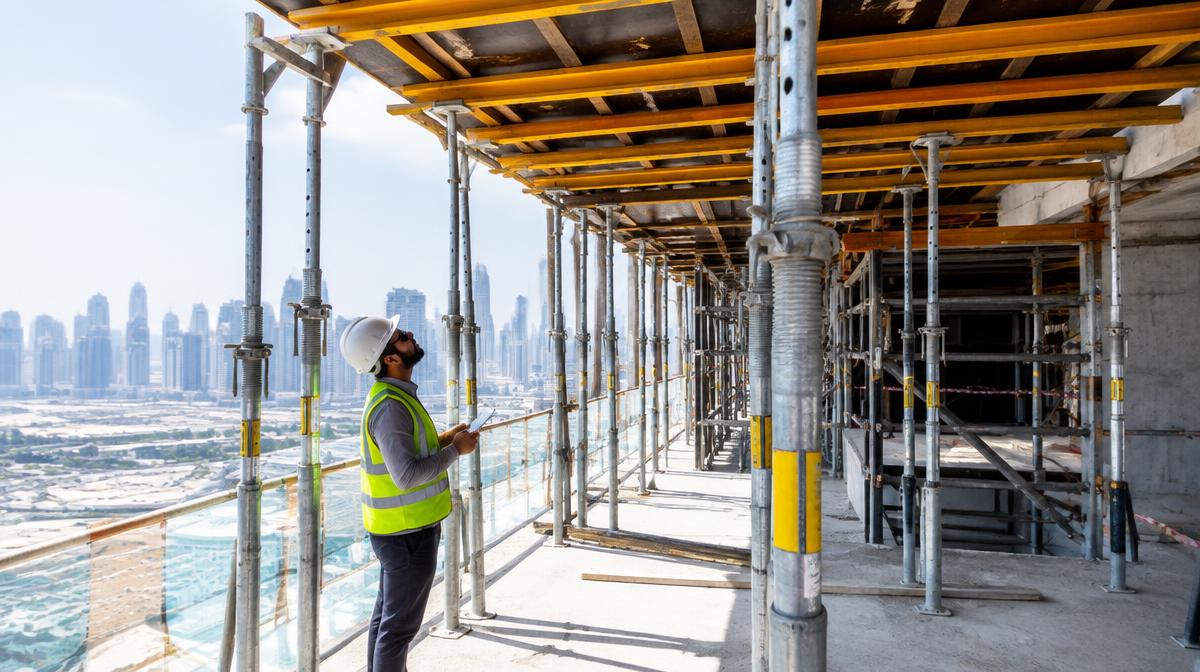
Ask a site team who owns the temporary works and the answer is usually a person — the formwork subcontractor, the temporary works engineer, the project engineer. Ask who owns the load path and the answer is often silence.
The load path is the question that decides whether a structure stands while it is being built: what is carrying the load now, what will carry it next, and what happens in the interval. Formwork and falsework, back-propping, excavation support, scaffolds, crane bases, edge protection, hoarding and temporary access all feed into it. When it is assumed rather than designed, checked and controlled, the failure mode is not a fall from height — it is a collapse with the crew on it.
In practice temporary works fail for a small number of reasons: nobody was appointed to coordinate them; the design was never independently checked; the erected condition did not match the drawing; something was altered on site for access; the striking time was decided by programme rather than by strength; or the load was transferred to a permanent element before it was ready to take it.
Run it as a register, not a folder
A temporary works register is the working document that keeps the load path visible. One line per temporary works item, with the fields that make a difference:
- Item and location — formwork to level 4 core wall, north elevation
- Class and consequence of failure — what happens if this fails
- Design responsibility — who produces the design, and their competence
- Check status — who checked it, when, and against what
- Approval to proceed — named approver, date, and any conditions
- Erection inspection — who inspected the erected item before loading
- Permit to load — issued before concrete or any imposed load
- Permit to strike — issued before anything is removed
- Back-propping and re-prop requirements, with durations
- Alteration history — every change, by whom, with re-approval
That is not bureaucracy for its own sake. Each field closes a gap that has contributed to temporary works failures.
The four statuses that matter
- Designed — a competent person has produced the design for the actual geometry, loads and sequence on this site, not a generic arrangement.
- Checked — someone independent of the designer has verified it. Self-certification of a high-consequence temporary work is not checking.
- Erected as designed — verified physically before loading, against the drawing, by someone with the competence to notice the difference. "Looks right" is not a check.
- Loaded and struck under control — a permit to load before the load arrives, a permit to strike before anything is removed, and the striking time based on strength gained rather than on the programme.
Failures tend to cluster at the third and fourth statuses — the handover from paper to site, and the point where commercial pressure meets the curing curve.
Where it goes wrong on site
- Alteration for access. A prop, brace or standard is removed to let a trade through and never reinstated, because the person removing it saw an obstruction rather than a load path.
- Early striking. The programme has a pour next week, so the striking time is moved. Nothing in the document changes; the strength of the concrete does not either.
- Back-propping assumed. Multi-storey back-propping is planned as "one level below" without a load calculation, and the load is carried by a slab that was never designed for it.
- Design not matching the geometry. The drawing shows a 900 mm shutter face; the site has 1,200 mm. The difference is never sent back.
- Excavation support installed, then undermined. Services excavation, a temporary sump, or a wheel wash cuts into the retained face below the support.
- No register for the small things. The major formwork is controlled; the loading platform, the hoist base or the temporary gantry over a live route is not, because nobody classified it as temporary works.
- Interface with permanent works. The permanent works engineer and the temporary works designer never agree who is checking the load arriving onto a partially completed structure.
Make it workable on a live project
Appoint one coordination point. One named temporary works coordinator is the difference between a system and an intention. The role is to hold the register, check that approvals exist before loading, and refuse to let an alteration happen without re-approval.
Classify by consequence, not by size. A small item can carry a fatal consequence — a temporary loading platform high on a facade, a hoist base, an edge protection detail with a large catch area. Classify by what fails if it fails.
Make the permit to load and the permit to strike real gateways. These are the two moments where an unapproved change becomes a structural risk. Tie them to the register entry, and make the site's habit "no permit, no pour / no permit, no strike", the same way no permit means no hot work.
Inspect what was built, against the drawing. A short, physical inspection with the drawing in hand before loading, recorded with a name and a time. This single habit catches the majority of site-induced temporary works problems.
Control alterations explicitly. Any change to a temporary work goes back through the same approval route, including changes made for one shift. If the site cannot get approval in time, the answer is not to proceed.
Agree the interface with permanent works in writing. Who confirms the receiving structure is capable, at what stage, and what is checked before load transfer. That conversation costs an hour and prevents the least visible failure mode of all.
The evidence you are choosing to have
When a consultant, client or authority reviews temporary works — or after any incident involving one — the reviewer asks a small set of questions: who designed it, who checked it, who approved it, did the site build what was drawn, was it inspected before loading, who authorised the strike, and what changed since. A register with permits and inspection records answers every one of those in minutes.
Without it, the site is reconstructing intent from photographs, WhatsApp messages and memory, and the load path is whoever is most persuasive in the room.
"Reference material, not legal advice. Temporary works design, checking and approval are engineering decisions that must involve competent temporary works engineers for the specific project."
Continue with
- Temporary Works and Formwork checklist — https://sitesafetyuae.com/site-checklists/temporary-works-formwork
- Deep Excavation and Temporary Works (awareness module) — https://sitesafetyuae.com/training/deep-excavation-temporary-works
- Excavation and Shoring checklist — https://sitesafetyuae.com/site-checklists/excavation-and-shoring
- Demolition and Strip-Out checklist — https://sitesafetyuae.com/site-checklists/demolition-and-strip-out
- Permits & High-Risk Work module — https://sitesafetyuae.com/modules/permits
- Documents & MSRA/RAMS module — https://sitesafetyuae.com/modules/documents
Site Safety UAE builds the HSE Operations Dashboard for UAE and GCC construction projects — permits, registers, inspections and approval records in one place. Start free, no card required — https://sitesafetyuae.com/get-started.
Recommended next reads
- Buried Services and Utility Strikes: Preventing the One That Stops the JobA utility strike can injure the crew, cut power or water to a neighbourhood, and stop the project for weeks. How UAE sites control excavation near buried services with records, detection, permits and emergency arrangements.Read guide
- Temporary Electrical Safety: The Installation That Grows Faster Than Its RecordsA site's temporary electrical installation is designed once and extended by everyone. How UAE projects keep protection, cabling, competence, isolation and testing records ahead of the growth.Read guide
- Excavation Safety in the UAE: Protective Systems, Surcharge and the Daily InspectionExcavation collapse gives no warning and leaves no time to rescue. How UAE projects select protective systems, control surcharge and water, inspect faces daily, and plan a realistic emergency response.Read guide
UAE HSE Legal Guide 2026
The consolidated PDF: federal and emirate-level HSE obligations, authority responsibilities and the evidence each inspection expects. Sent to your inbox.
Browse everything in the UAE HSE Compliance Hub.
For safety officers
Sign in to the safety officer portal for your daily reports, the hazards whose controls still need verifying, and the authority forms waiting on a decision.
See it in action
Site Safety UAE is a software-only platform. Watch the recorded demo to see the modules covering your project scope and authority mix.
Watch the demo