
Article
Buried Services and Utility Strikes: Preventing the One That Stops the Job
A utility strike can injure the crew, cut power or water to a neighbourhood, and stop the project for weeks. How UAE sites control excavation near buried services with records, detection, permits and emergency arrangements.
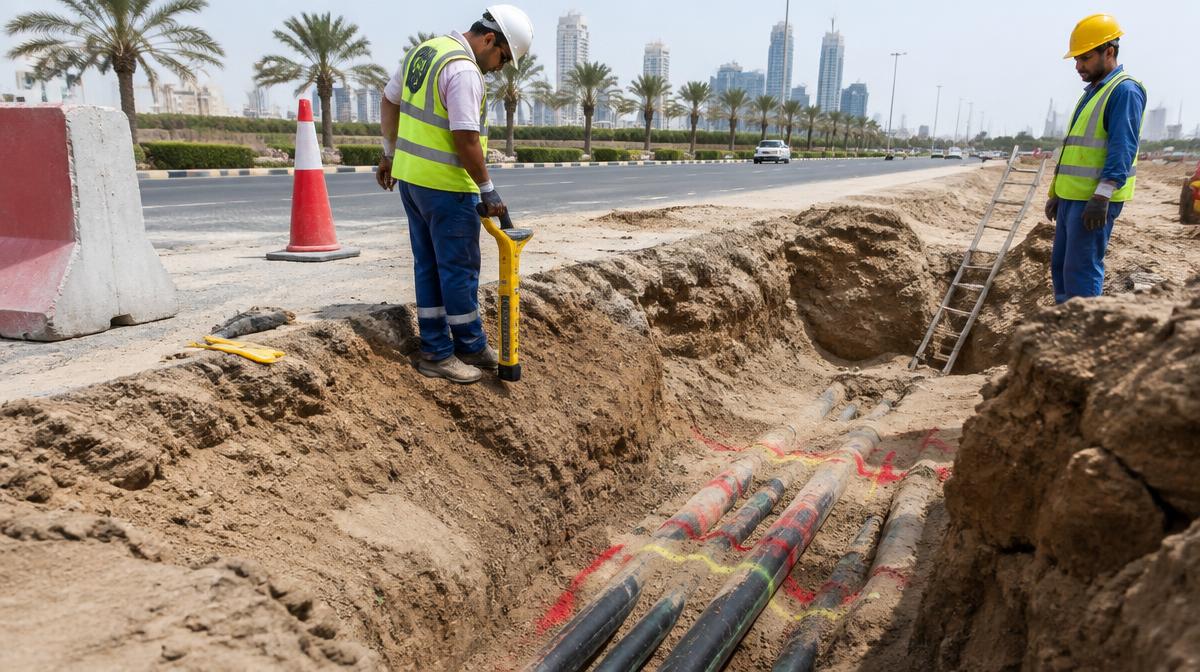
An excavator bucket through an 11 kV cable, a gas main, a water transmission line or a fibre trunk is one of the few construction events that can injure the operator, endanger a third party, cut a service to people who are not on the project at all, and stop work for weeks while an authority, a client and a utility provider work out what happened.
Excavation is planned, permitted and supervised on most UAE sites. What is often thin is the specific discipline around buried services — and that discipline is almost entirely about what you know before the bucket moves.
What you need before you dig
- The service records you can obtain. Drawings and records from the relevant utility providers and authorities, the client, the previous landowner, and any earlier contractor. Treat every record as indicative: as-built records drift, services get laid deeper or shallower than drawn, and unmapped connections exist. A drawing tells you where to be careful, not where it is safe.
- Detection where records are thin. Cable avoidance tools, ground-penetrating radar and other non-invasive detection, used by someone competent, with the results marked on the ground and dated.
- Trial pits. Hand-excavated pits to positively locate a service before machine excavation approaches it. Slow, unglamorous, and the single most effective control on this hazard.
- Marking on the ground. Spray or pegs at the surface, matching the drawing, with the service type, depth where known and date. Markings fade; re-mark when they do.
- A permit system that names the dig. Excavation permits that record the service search, the detection result, the trial pit outcome, the digging method and the supervision.
- A stated machine exclusion. The distance from a service at which machine excavation stops and hand work begins — set for the specific service and ground conditions, briefed to the operator, and physically marked.
Control the dig, not just the service
- Sequence the work so services are dealt with before mass excavation where possible, and never let a service be exposed by a bucket as a discovery method.
- Hand-dig, then support. Once a service is exposed, it needs support — a struck or unsupported gas main or duct bank is a new problem created by the one you were solving.
- Watch the operator. Banksman and spotter in position with a clear stop signal, agreed in the brief, and used without hesitation.
- Keep the exclusion zone current. Route plant so tracked machines and delivery vehicles cannot cross the marked corridor, and re-check after rain when markings and ground conditions change.
- Coordinate isolations properly. Where a service must be isolated, the isolation belongs to the provider — not to the site team. Plan the window, the switch-off, the lock-off, and the re-energisation in advance, with the provider's requirements and records in hand.
- Brief the crew on the specific service, not on the general rule. "There is a live 11 kV duct crossing at 2.1 m, running east-west along this line, and the machine stops 1.5 m from the marking" is a brief. (The depth and stand-off in that example are illustrative only; actual clearances come from the utility provider and the permit.) "Watch out for services" is not.
The permit-to-dig that holds up
A dig permit is worth having when it forces four answers before excavation starts: what services are known or suspected here, what detection and trial pits were completed, what method and separation apply, and who supervises and how the work stops. Add the close-out — where the service was found, at what depth, and whether the drawing matched — and the next excavation on the same alignment gets better information than this one did.
That last point is the one most sites miss. Recording where the service actually was, against where the drawing said it was, is how a project builds its own reliable picture in a site where the official records are approximate.
When it goes wrong
The response is decided before, not during:
- Stop, withdraw and exclude. Machine off, area cleared to a distance appropriate to the service, nobody touching the damaged asset.
- Protect people first, then the asset. Gas: remove ignition sources, no switching, evacuate upwind. Electricity: no approach to a damaged cable, including the machine, until confirmed isolated. Water: exposure and flooding risk to the excavation, and to anything below it.
- Notify immediately and correctly. The utility provider and the authority, the client, and the site's emergency contacts. The provider controls the repair and the re-energisation; the site controls the scene, the access and the people.
- Do not attempt a repair. Temporary repairs by site staff on a live or recently damaged service create a second, worse event and remove the site's ability to argue it acted properly.
- Preserve the evidence. Photographs, the depth, the marked alignment, the permit and briefing records, and the detection records. A strike investigation turns on exactly those documents.
- Learn from it before the dust settles. Update the drawing set, the HIRA entry, and the briefs for every other excavation on the alignment.
Make it part of the excavation routine
Buried services are not a separate safety topic. They belong in the same chain the site already runs for excavation: the assessment that names the hazard, the permit that authorises the dig, the brief that names the specific service line, the physical marking and separation, the supervision present during the dig, and the close-out that feeds the drawing set.
Where that chain exists, a utility strike becomes a rare event caused by a genuine record failure rather than a routine consequence of digging in a busy city.
"Reference material, not legal advice. Requirements differ by emirate, authority and client. Service clearances, isolation and emergency notification must follow the specific utility provider's requirements for each asset."
Continue with
- Excavation and Shoring checklist — https://sitesafetyuae.com/site-checklists/excavation-and-shoring
- Excavation Readiness: Treat the Edge as a Controlled Workfront — https://sitesafetyuae.com/resources/monday-excavation-edge-protection
- Plant, Vehicles and Traffic checklist — https://sitesafetyuae.com/site-checklists/plant-vehicles-traffic
- Below-Ground & Confined Assets — https://sitesafetyuae.com/solutions/below-ground-confined-assets
- Permit-to-Work: Five Questions Before Any High-Risk Task Starts — https://sitesafetyuae.com/resources/monday-permit-to-work-handover
- Permits & High-Risk Work module — https://sitesafetyuae.com/modules/permits
Site Safety UAE builds the HSE Operations Dashboard for UAE and GCC construction projects — permits, utility search records, briefings and inspection evidence in one place. Start free, no card required — https://sitesafetyuae.com/get-started.
Recommended next reads
- Temporary Works: The Load Path Nobody Owns on a UAE SiteFormwork, falsework, back-propping and excavation support fail when the load path is assumed rather than designed and checked. How UAE projects run a temporary works register, approvals and striking controls that hold up.Read guide
- Dynamic Risk Assessment: What Changes Between the Signed MSRA and the WorkfaceThe MSRA was correct on Monday morning. By Wednesday the same document describes different conditions. How UAE sites re-check risk at the workface, record it, and make stop-work authority usable.Read guide
- Excavation Safety in the UAE: Protective Systems, Surcharge and the Daily InspectionExcavation collapse gives no warning and leaves no time to rescue. How UAE projects select protective systems, control surcharge and water, inspect faces daily, and plan a realistic emergency response.Read guide
UAE HSE Legal Guide 2026
The consolidated PDF: federal and emirate-level HSE obligations, authority responsibilities and the evidence each inspection expects. Sent to your inbox.
Browse everything in the UAE HSE Compliance Hub.
For safety officers
Sign in to the safety officer portal for your daily reports, the hazards whose controls still need verifying, and the authority forms waiting on a decision.
See it in action
Site Safety UAE is a software-only platform. Watch the recorded demo to see the modules covering your project scope and authority mix.
Watch the demo