
Article
Dynamic Risk Assessment: What Changes Between the Signed MSRA and the Workface
The MSRA was correct on Monday morning. By Wednesday the same document describes different conditions. How UAE sites re-check risk at the workface, record it, and make stop-work authority usable.
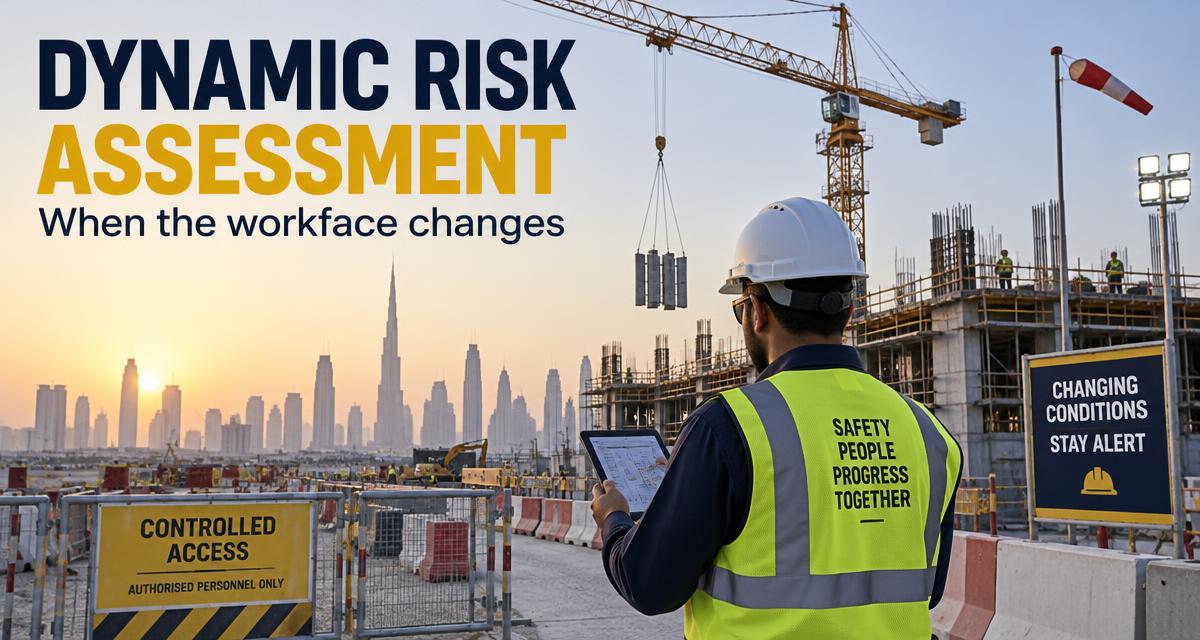
The MSRA was written on Monday for a job that started Wednesday. In between, the wind picked up, a different crane crew arrived, the adjacent contractor started pouring on the other side of the same access route, and the afternoon heat pushed the programme into a longer evening shift under temporary lighting.
Nothing in the pack is wrong. It is simply describing a site that no longer exists in that form.
Static assessment and dynamic assessment are not two competing approaches — they answer different questions. The static pack tells the project how this work should be done. The dynamic check tells the crew whether it can be done as described, right now, here. Every serious incident investigation on a construction site eventually arrives at the gap between the two.
What each one covers
| Static assessment (MSRA / RAMS / HIRA entry) | Dynamic assessment (at the workface) | |
|---|---|---|
| Written by | HSE and engineering, with the supervisor | Supervisor and crew |
| Done | Before the activity, at planning stage | Immediately before and during the work |
| Covers | Method, sequence, controls, competence, emergency arrangements | Actual conditions, actual people, actual interfaces today |
| Changes | By revision, with re-approval | By the minute |
| Record | Controlled document with revision number | Short field record, time-stamped, with a name |
| Authority | Authorises the activity in principle | Authorises it to continue — or stops it |
A project needs both, and needs them linked: the dynamic check should be able to say "the MSRA says X, the site is now Y, so we are doing Z."
The triggers that should force a re-check
Not every shift needs a ceremony. These are the changes that must produce one:
- Heat and the midday break — work pushed into early morning or evening, with different light, different supervision coverage and different fatigue
- Wind and weather — lifting limits, scaffold sheeting, work at height, dust, standing water and access
- Shift change — the night crew inherits the setup, the isolations and the permit conditions
- A new crew, subcontractor or supervisor on the same workfront
- Temporary works changed, moved or partly struck — including scaffold alterations and edge protection removed for access
- Adjacent trade or SIMOPS — another permit live in the same area, or plant routes that now cross
- Plant or equipment substitution — a different machine, attachment or capacity
- Ground conditions, excavation faces, or water levels that moved
- Any incident or near miss in the area, including one that happened to somebody else's crew
- A first-time activity for the crew, even if it is routine for the project
The five-minute field check
A dynamic assessment that takes half an hour will not happen. Keep it to five questions, answered out loud with the crew, standing at the workface:
- What has changed since this was assessed — conditions, people, plant, sequence, interfaces?
- Who is exposed now, including people who are not part of this task?
- Which control fails first if the change continues — barrier, isolation, exclusion, access, communication?
- Who owns it — the named person who will fix it before work continues?
- What do we do now — proceed as assessed, modify, or stop?
The output is a decision, not a document. The record is one line.
Make stop-work authority usable
Most UAE projects have a stop-work policy. Far fewer have crews who use it, because the practical cost of stopping feels higher than the practical cost of continuing for one more hour. That is a management problem, not a workforce problem, and it is fixed by behaving consistently:
- Name the triggers: anyone may stop work where a critical control is absent, a condition has changed beyond the assessment, or they cannot see how the task is controlled.
- Make the response predictable: the supervisor attends, the situation is made safe, the assessment is revisited with the crew, and the work restarts only when the control is restored.
- Never resolve a stop by moving the person who raised it. One visible case of that ends the policy on the whole site.
- Record stops as data. A rising number of stops in a month is usually better supervision, not a worse site.
Recording it so it is auditable
The record has to be short enough that a busy supervisor completes it honestly, and complete enough that a reviewer can reconstruct the decision later. Four fields are enough: time, location and task; what changed; the decision taken and who made it; the action and who owns it.
Photographs are the cheapest evidence on a construction site: the same location, the same camera, before and after. It answers in one image the question an investigation will spend a week on — what did this area actually look like when the crew was told to proceed?
Link the record to the work it belongs to. A dynamic check that cannot be attached to the permit, the MSRA revision or the task it modified is a note in a book. Attached to the permit, it becomes part of the evidence that the site was controlled as conditions changed.
Coach it rather than audit it
Supervisors learn this by doing it with someone experienced, not by reading a form. Two practices that work on UAE projects:
- In the morning brief, take one trigger from the list above and ask the crew how they would spot it and what they would do. Thirty seconds per shift, and the vocabulary spreads.
- On site, ask the five questions yourself at a workface, out loud, in front of the crew. The behaviour is copied long before the procedure is read.
Then measure something that reflects it: dynamic checks completed per shift on high-risk activities, changes that produced a revised method, stops raised and closed, and the time between a change being identified and the control being restored. Those are leading indicators, and they move before the lagging numbers do.
The static pack will always be one document behind the site. The dynamic check is how the site stays ahead of it.
"Reference material, not legal advice. Requirements differ by emirate, authority and client."
Continue with
- Start the Week Safe: The 10-Minute Pre-Task Brief That Changes the Shift — https://sitesafetyuae.com/resources/monday-start-safe-pre-task-brief
- Permit-to-Work Handover: Five Questions Before Any High-Risk Task Starts — https://sitesafetyuae.com/resources/monday-permit-to-work-handover
- SIMOPS Coordination: One Work Area, One Shared Risk Picture — https://sitesafetyuae.com/resources/monday-simops-coordination
- Inspections & Incidents module — https://sitesafetyuae.com/modules/inspections — capture field checks, observations and near misses where they happened
- Heat Stress & Midday Break Readiness Checklist (UAE) — https://sitesafetyuae.com/resources/heat-stress-summer-readiness-checklist-uae
Site Safety UAE builds the HSE Operations Dashboard for UAE and GCC construction projects. Field capture, permits, inspections and audit evidence in one system — start free, no card required — https://sitesafetyuae.com/get-started.
Recommended next reads
- Pre-Task Briefings That Change What Crews DoA briefing that lists generic hazards gets signed and forgotten. A short, task-specific briefing with a question for the crew gets remembered. How to run one.Read guide
- The 5×5 Risk Matrix on UAE Sites: Why the Scores Drift and How to Calibrate ThemThe same hazard gets a 4×4 on one MSRA and a 2×3 on another in the same week. How to define likelihood and severity bands, calibrate scoring across a UAE project, and make residual ratings mean something.Read guide
- Permit to Work at Shift Handover: Where Controls Quietly DisappearA permit that was safe at 06:00 is not automatically safe at 14:00. How to hand over open permits, isolations and exclusion zones so the controls survive the change of crew.Read guide
UAE HSE Legal Guide 2026
The consolidated PDF: federal and emirate-level HSE obligations, authority responsibilities and the evidence each inspection expects. Sent to your inbox.
Browse everything in the UAE HSE Compliance Hub.
For safety officers
Sign in to the safety officer portal for your daily reports, the hazards whose controls still need verifying, and the authority forms waiting on a decision.
See it in action
Site Safety UAE is a software-only platform. Watch the recorded demo to see the modules covering your project scope and authority mix.
Watch the demo