
Article
Excavation Safety in the UAE: Protective Systems, Surcharge and the Daily Inspection
Excavation collapse gives no warning and leaves no time to rescue. How UAE projects select protective systems, control surcharge and water, inspect faces daily, and plan a realistic emergency response.
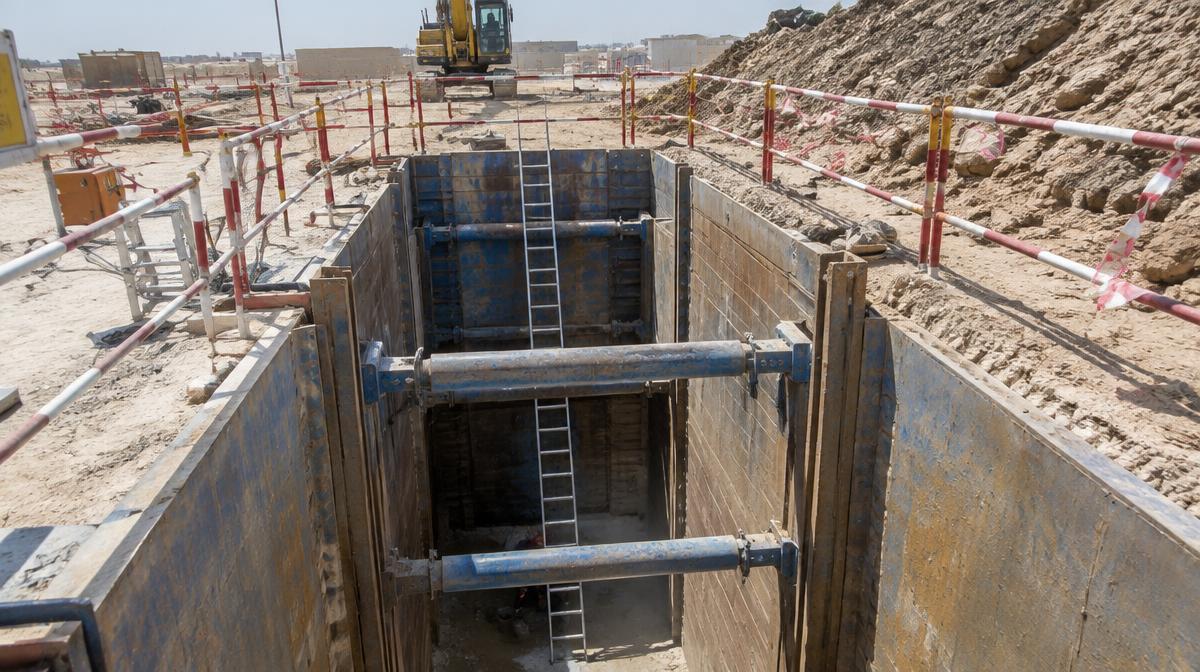
Excavation collapse is the hazard with the shortest interval between cause and consequence on a construction site. A face that has stood for three weeks gives no warning before it comes in, and a person buried to the chest cannot breathe — the weight of soil compresses the chest and prevents the expansion that breathing requires. A cubic metre of soil weighs well over a tonne, which is why "dig him out" is not a rescue plan.
Every control that matters therefore happens before anyone goes into the ground: the protective system, the loads on the face, the water, and the inspection regime that catches the change before it becomes a collapse.
The ground is the design input, and it is often not what the drawing says
Excavation design assumes a ground condition. On a UAE site, that assumption is frequently wrong in ways that matter:
- Made ground and previous backfill. Excavations filled in years ago by another contractor behave nothing like the natural ground beside them.
- Utility trench backfill. Loose, uncompacted material running through the face, often directly where a person will be working.
- Sand and sabkha. Free-draining and weak when saturated, and prone to sudden loss of stability when water arrives.
- Variable groundwater, with dewatering that is either working, partially working, or switched off overnight.
- Adjacent loads — roads, structures, plant, stockpiles — that were not part of the original assessment.
The practical consequence: treat any classification of the ground as provisional, and let a competent person select or design the protective system for the depth and conditions actually present — not for the conditions assumed at tender.
Protective systems: selected, not improvised
There are three families of protection, and each has to be matched to the excavation rather than assembled from what is available:
- Battering and benching — cutting the sides back to a stable angle. It works only where there is space, where the ground will hold that angle, and where nothing loads the top.
- Shoring — supporting the face with trench sheets, frames, hydraulic or mechanical systems, or sheet piling.
- Shielding — a trench box or similar, which protects the people inside it but does not support the face.
Three rules that decide whether any of them works:
- The system is installed before entry, not after. A trench box that is lowered into a dug excavation after people have been working in it unprotected has protected nobody. Excavation and support advance together.
- The protection extends above the surface where it must retain falling material and spoil, and it is installed to the designer's or manufacturer's instructions — the depth rating, the spacing, the sequence.
- No one is in an unprotected excavation at any depth where they could be buried. Depth alone is a poor trigger; a 1.2 m face of loose backfill buries a person kneeling to make a connection just as effectively as a 4 m face of sand.
Surcharge: the load nobody counts
A face fails because something pushed it. The loads are usually placed there deliberately and never thought of as loads:
- Spoil heaped at the edge — the single most common surcharge on a construction site.
- Plant tracking or parked along the excavation line, including the excavator that dug it.
- Materials — pipes, reinforcement, blocks, pallets, concrete wagons waiting to pour.
- Adjacent structures and roads, and the traffic loading they carry.
- Water from a leaking main, irrigation, wash-down, or a tanker filling next to the cut.
The control is a setback distance that the protective system's design accounts for, marked physically on the ground, with plant routes and storage positions planned around it rather than drifting into it. Where the setback cannot be maintained, the system has to be designed for the load that is actually there.
Water is the classic trigger
Many excavation collapses involve water arriving where it was not expected: overnight rain, a dewatering pump that stopped, a burst water line, an irrigation leak, or wash-down water running into the cut. Water changes the ground's strength, adds hydrostatic pressure, and softens the toe of the face.
What holds up:
- Dewatering that is monitored, with pump status, discharge and levels checked rather than assumed — and a plan for what happens if it fails out of hours.
- Trigger levels for movement, water level or crack width, agreed in advance, with defined actions when they are reached rather than a discussion.
- Run-off control so surface water goes somewhere other than the excavation.
- A re-inspection after any water event, before work resumes, and a documented decision that the face is still stable.
Inspection: daily, recorded, and by a competent person
An excavation inspection is not a weekly form. The regime that works is:
- Before work starts each shift, with the result recorded, covering the faces, the support, the setback, the access, the edge protection and the water.
- After any event that could have changed the ground or the support — rain, a vehicle impact, ground movement, a pump failure, plant working close to the edge.
- During the work, by the supervisor, because a face can change within a shift as the excavation advances or the spoil is moved.
- By someone competent to judge stability, not simply to complete a checklist.
The record matters as much as the inspection: what was found, what was done, by whom, and when work was stopped. It is also the only way to see a pattern of deterioration developing over days.
Access, edges and the people above
- A ladder or ramp within reach of anyone working in the excavation, secured, with the top projecting above the surface and the opening protected. Nobody climbs the shoring, and nobody jumps in.
- Edge protection, barriers and signage at the surface, on every side that people can approach, including the side that only opens during a delivery.
- Plant and people separated: the excavator's slew radius marked, workers excluded from the bucket zone, and a banksman where the operator's view is restricted.
- Nothing stacked where it can fall in — materials, tools, loose spoil, and the debris that accumulates at the edge of every excavation.
Atmosphere in deep excavations
Deep cuts, shafts, pits and basements can accumulate exhaust gases, heavier-than-air vapours or an oxygen-deficient atmosphere, particularly where plant is running inside, where coatings or solvents are in use, or where the excavation is enclosed. Where the assessment says the space meets the criteria, it is treated as a confined space, with the isolation, testing, entry control and rescue arrangement that implies — not as an excavation that happens to be deep.
A realistic emergency plan
The honest starting point is that a person buried in a collapse is very unlikely to be rescued alive by a team digging by hand, and that untrained colleagues who jump in to dig become the next casualty as the face continues to move. The plan should say so, and then work backwards:
- Stop, withdraw and count. Everyone out, headcount against the entry log, the area cleared, and the plant shut down.
- Do not send people into the face. Rescue from the edge, using the protective system, under the direction of a competent person, with the support made safe first.
- Call for the specialist capability — the civil defence service and the contractor's own rescue arrangements, with the access route for equipment planned in advance.
- Have the information ready: the depth, the support system, the ground conditions, the services present, and the location of the person. That information is what makes an external rescue possible.
- Treat the recovery of a body with the same protection standards as any other entry. The instinct to recover quickly is what produces a second fatality.
What the evidence looks like
For each excavation: the assessment naming the ground conditions and the services, the design or selection record for the protective system, the permit where one is required, the daily and post-event inspection records, the monitoring and trigger level records, the briefing records, the competence records for the people supervising and inspecting, and the emergency plan with the arrangements confirmed.
That set demonstrates that the excavation was controlled as a structure with people in it — which is what it is.
"Reference material, not legal advice. Requirements differ by emirate, authority and client. Excavation design, protective system selection and inspection must be carried out by competent persons, and deep or complex excavations require engineering design."
Continue with
- Excavation Readiness: Treat the Edge as a Controlled Workfront — https://sitesafetyuae.com/resources/monday-excavation-edge-protection
- Excavation and Shoring checklist — https://sitesafetyuae.com/site-checklists/excavation-and-shoring
- Excavation and Trenching (awareness module) — https://sitesafetyuae.com/training/excavation-trenching
- Excavation Monitoring and Trigger Levels (awareness module) — https://sitesafetyuae.com/training/excavation-monitoring-trigger-levels
- Working Inside an Active Excavation (awareness module) — https://sitesafetyuae.com/training/work-inside-active-excavation
- Flooded Excavation and Collapse Emergency (awareness module) — https://sitesafetyuae.com/training/flooded-excavation-collapse-emergency
- Deep Excavation Handover and Rescue (awareness module) — https://sitesafetyuae.com/training/deep-excavation-handover-rescue
- Buried Services and Utility Strikes: Preventing the One That Stops the Job — https://sitesafetyuae.com/resources/buried-services-utility-strike-prevention-uae
Site Safety UAE builds the HSE Operations Dashboard for UAE and GCC construction projects — excavation permits, inspection records, monitoring data and briefing evidence in one place. Start free, no card required — https://sitesafetyuae.com/get-started.
Recommended next reads
- Excavation Cave-In Prevention on UAE SitesSoil variability across the UAE — sabkha, calcareous sand, weathered rock — makes excavation shoring decisions harder than the textbook implies. This guide covers the 2026 baseline.Read guide
- Buried Services and Utility Strikes: Preventing the One That Stops the JobA utility strike can injure the crew, cut power or water to a neighbourhood, and stop the project for weeks. How UAE sites control excavation near buried services with records, detection, permits and emergency arrangements.Read guide
- Temporary Works: The Load Path Nobody Owns on a UAE SiteFormwork, falsework, back-propping and excavation support fail when the load path is assumed rather than designed and checked. How UAE projects run a temporary works register, approvals and striking controls that hold up.Read guide
UAE HSE Legal Guide 2026
The consolidated PDF: federal and emirate-level HSE obligations, authority responsibilities and the evidence each inspection expects. Sent to your inbox.
Browse everything in the UAE HSE Compliance Hub.
For safety officers
Sign in to the safety officer portal for your daily reports, the hazards whose controls still need verifying, and the authority forms waiting on a decision.
See it in action
Site Safety UAE is a software-only platform. Watch the recorded demo to see the modules covering your project scope and authority mix.
Watch the demo