
Article
Scaffolding Safety in the UAE: Platform Widths, Ties, Inspection and the Alteration Problem
Scaffolding is one of the most strictly regulated and most frequently altered structures on a UAE site. The platform width, guardrail gap, design trigger and inspection rules that apply, and the site practices that keep a scaffold compliant.
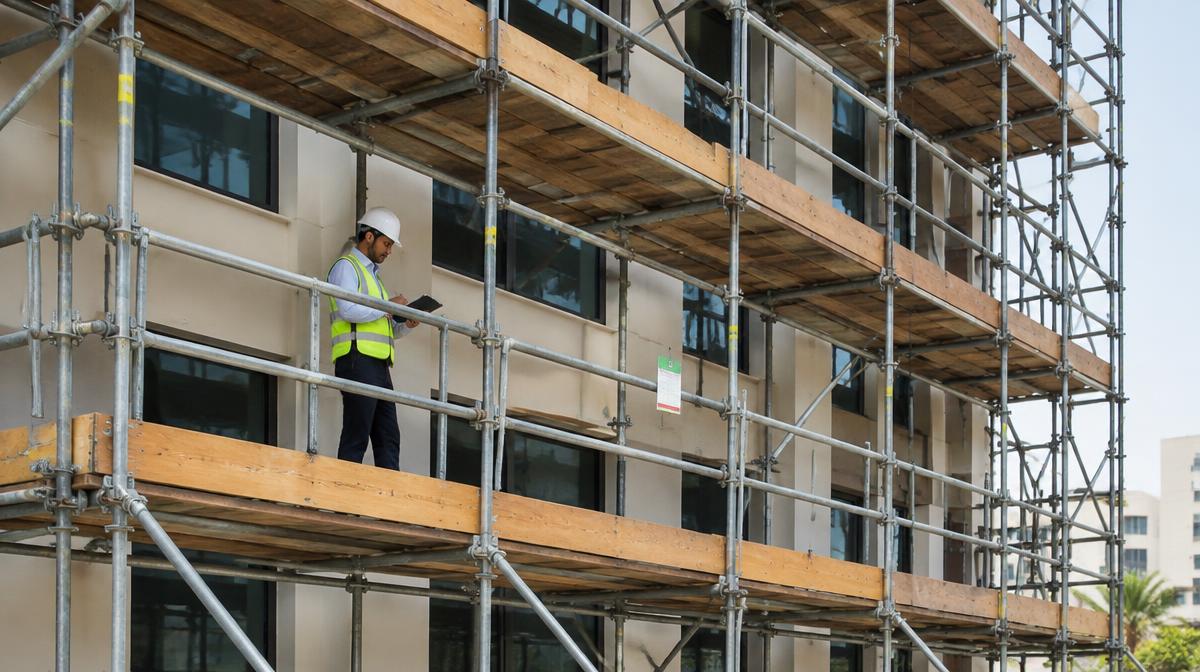
Scaffolding is one of the most heavily regulated temporary structures on a construction site, one of the most likely to attract an inspection, and one of the most likely to be altered by people who did not build it. It is erected under time pressure in wind, rain, heat and dust, used by every trade on the project, modified for access by whoever needs to get through, and then trusted by people working at height on it.
That combination explains why scaffolding is treated more strictly than almost any other activity in the UAE — and why the rules, the inspection regime and the alteration discipline all matter more than the average safety topic. This guide covers what the published UAE requirements actually say, what they mean in practice, and where sites lose compliance between handover and use.
The requirements are not one set of rules
There is no single UAE scaffolding standard. Depending on where the project sits and who regulates it, the requirements come from different authorities, and they differ in detail that matters.
- In Abu Dhabi, the ADOSH-SF Code of Practice 26.0 v4.1 sets minimum working platform widths, specifies a maximum gap beside the intermediate guardrail, and defines when a design is required.
- In DDA-regulated Dubai zones, Dubai Development Authority Circular 656 of 16 March 2026 requires scaffold inspection by an EIAC-accredited body, with the certificate carrying the EIAC logo and a secure-record QR code, and valid for no more than one week.
- Other emirates and other authorities — municipal, free zone, civil defence and client-specific — operate their own regimes and their own inspection expectations.
Before any scaffold goes up, establish which requirements apply to this project, in this location, and record that determination. A scaffold that satisfies a rule from the wrong emirate is not a compliant scaffold.
The TG20 trap
UK TG20 guidance is widely used in the UAE as a reference for system scaffolds, and it is frequently cited as though it were a local requirement. It is not UAE law. It only applies where the as-built scaffold matches the compliance sheet for that configuration — the moment the bays, ties, platform widths or loading differ from the sheet, the compliance sheet no longer describes the structure on site and provides no cover at all.
What the published rules say, and what they mean on the ground
For Abu Dhabi projects under ADOSH-SF CoP 26.0 v4.1, the key parameters are specific enough to check with a tape:
| Requirement | What it means in practice |
|---|---|
| Minimum working platform width of 800 mm where the platform is for persons only | The platform is sized for people and their hand tools, not for materials |
| 1.0 m where materials are stored on the platform | Storing anything on a scaffold platform changes the width requirement — and the loading assumption |
| 1.2 m for masonry work | Where block or stone is being laid, the platform has to support the work and the operative |
| 600 mm permitted only for short-duration light work | A narrow platform for a quick task, not a working platform for a shift |
| Maximum gap beside the intermediate guardrail of 470 mm | This is a gap dimension at the intermediate rail, not the height of the guardrail — the single most misread number in scaffold compliance |
| A design is required above 10 m and for specified non-standard configurations | Height and configuration are the two triggers that convert a standard system scaffold into a designed structure |
| Tie spacing is not fixed numerically in the code | Ties follow the designer's, manufacturer's or supplier's instructions for the configuration actually built — not a spacing remembered from another project |
Two habits follow from that table. First, measure rather than assume: platform width and the guardrail gap are checkable with a tape measure at any time by anyone. Second, keep the design and the manufacturer's instructions with the scaffold, because the tie pattern, the bay lengths and the loading all depend on them.
Foundations, ground and the undermining problem
A scaffold stands on the ground, and the ground on a construction site changes.
- Base plates on sole boards, on ground that has been prepared for the load rather than on whatever surface happens to be there.
- Ground bearing checked for the leg loads the design assumes — not for the fact that a leg is standing on something.
- Undermining is the classic failure. A drainage run, service trench, sump or excavation opened alongside a scaffold leg removes its support without touching the scaffold. Whenever excavation happens near a scaffold, the scaffold is part of the conversation before the digging starts.
- Ties anchored to something structural. A tie fixed to cladding, a temporary fixing, a block wall not designed for the load, or the scaffold's own neighbouring standard anchors nothing. Where the structure cannot take a tie at the required position, the design has to address it.
- Load on temporary structures. A scaffold founded on a slab, a platform or a suspended structure transfers its load into something that may not have been designed to receive it.
Ties: the defect that takes a scaffold down
Ties hold the scaffold against the structure. They are removed, damaged or never installed far more often than any other component, and their removal is usually invisible until the wind loads the scaffold.
The three sources are predictable:
- Finishing trades — plasterers, painters, tilers, cladders and window fixers remove a tie to reach the structure behind it, intending to replace it later.
- Access — a tie obstructs a route, a material drop or a hoist position, so it is moved.
- Never installed — a tie pattern in the design that was not followed during erection, which nobody can see from the platform.
The control is deliberate and cheap: mark and record the tie positions, brief every trade that no tie is to be removed or altered under any circumstances, put a visible warning at each tie, inspect the ties after the trades move through an area, and treat a missing tie as a stop-work condition on the affected bay until the scaffold provider reinstates it.
Loading, duty and the platform that becomes a store
A working platform is designed for a duty classification — the load it is intended to carry — and the boards have a capacity that is easy to exceed without any intention of doing so: a stack of block, a pallet of render, an air compressor, a skip full of rubble.
- Post the duty on the scaffold, and make sure the people working on it can read it.
- Materials go where the design allows, not wherever there is space.
- Concentrated loads — a pallet placed between standards rather than over them, or stored against a single bay — are the loads that break boards and push off platforms.
- Never remove boards to pass materials up, and never use a scaffold as a materials hoist unless it has been designed and handed over for that purpose.
- Keep the deck clear of the debris that accumulates on scaffolding precisely because nobody thinks of it as a working area.
Access and egress
Access is prescribed by the design too: proper ladder access with a hatch, or an internal staircase, with the ladder secured, the opening protected and the platform guarded where the ladder arrives.
The failures are mundane and lethal in equal measure: climbing the outside of the scaffold frame, hopping the guardrail between platforms, dropping tools and materials from height because the platform has no toe boards, using the scaffold while it is still being erected, and moving a mobile tower with people or materials on the platform.
Alterations: the most common root cause
If one habit separated compliant sites from non-compliant ones, it would be this: the scaffold is never altered by anyone other than the people qualified to alter it, and every alteration is recorded and re-inspected.
The rules a site can enforce without technical knowledge:
- Any change to a scaffold — a standard, a tie, a board, a guardrail, a bay, a platform level — goes back to the scaffold provider or an authorised scaffolder. No exceptions for "just one board for a minute".
- After any alteration, the scaffold is re-inspected before it is used again, and the handover record is updated. The certificate or tag that was valid before the alteration no longer describes the structure.
- The alteration is recorded, with what changed, who did it, when, and what was re-checked. This is the record that answers the question after an incident.
Inspection: the regime, and the one-week rule
Scaffold inspection is not a single event at handover. The regime that holds up covers every point at which the structure changes or is exposed:
- Before first use, after erection — inspected by a competent person before anybody works from it.
- Periodically, at the interval the applicable requirement sets. In DDA-regulated zones, that means inspection by an EIAC-accredited body with a certificate valid for no more than one week — so weekly re-inspection is a compliance obligation, not a scheduling preference.
- After any alteration, before re-use.
- After adverse weather — high wind, storm or heavy rain that could have moved, loaded or undermined the structure.
- After any incident or impact — a plant strike, an overload, a fall, or material dropped onto a platform.
- Recorded every time, with the location, the result, the inspector, the date and the next due inspection.
Where inspection is required to be carried out by an accredited body, keep the certificate on site and current, and make sure the certificate in the file describes the scaffold that is actually standing there — same bays, same heights, same ties.
Handover, tags and the scaffold register
The handover record is the scaffold's identity document: location, configuration, duty, the inspection history, and the period of validity. The tag or sign at the access point communicates the same thing to the person about to climb it.
The rules that make tags work:
- A tag carries the current status, the inspection date, the duty and who inspected it. A tag nobody can read is decoration.
- Only the competent person who inspected the scaffold changes its status. Nobody removes a tag to get a job finished, and nobody re-tags a scaffold by hand-writing on an old card.
- A scaffold with no valid tag or handover record is not used — the same standing rule as a machine with no inspection in date.
- Keep a scaffold register at project level: every scaffold, its location, its configuration, its duty, its last inspection and its next inspection due. That register is what stops scaffolds from becoming anonymous structures that outlive everyone's memory of who built them.
Competence
Scaffolders, and the person who inspects the scaffold, must be competent for the work — including the more complex configurations, which need more than basic competence. The inspector needs the knowledge to identify what is wrong, not just to tick a form.
On a UAE project this means verifiable records: cards or certification, the identity check that matches the person to the document, and a training matrix that shows who is qualified to erect, alter, inspect or dismantle. Where that verification is manual, it fails on the day it is tested.
Dismantling
Striking a scaffold is a high-risk operation in its own right: planned sequence, exclusion zone below and around, materials lowered rather than dropped, ties removed last in the designed sequence, and no partial dismantling left standing overnight without re-checking stability and protection. A scaffold half-struck at the end of a shift is a new structure with a new risk profile, and it needs an inspection before anyone goes near it.
The failures that recur
- Missing or removed ties, and no re-inspection after trades have been through the elevation.
- Platform widths that do not match the work being done, including materials stored on a platform never designed for them.
- The 470 mm gap beside the intermediate guardrail misread as a guardrail height, producing a protection detail that is wrong in a way nobody questions.
- No design where the height or configuration required one.
- Alterations made by unauthorised people, with no record and no re-inspection.
- Inspection certificates out of date, or describing a different configuration to the one on site.
- Scaffolds founded on ground undermined by a nearby excavation.
- TG20 compliance sheets relied on for scaffolds that do not match the sheet.
Give the scaffold an owner
The reason scaffolds drift out of compliance is that they are nobody's structure by default: the subcontractor built it, the trades use it, the site team walks past it. Compliance returns the moment one named person owns the register, the inspections and the alteration rule — and the site accepts that a scaffold without a valid handover record is not a scaffold you are allowed to stand on.
"Reference material, not legal advice. Scaffolding requirements differ by emirate, authority and client, and the requirements cited here are those published for Abu Dhabi (ADOSH-SF CoP 26.0 v4.1) and DDA-regulated Dubai zones (Circular 656). Confirm the requirements that apply to your project, and have all scaffolding designed, erected, altered and inspected by competent persons."
Continue with
- Scaffold Handover: Confirm Access Before the First Climb — https://sitesafetyuae.com/resources/monday-scaffold-handover
- UAE Scaffolding Safety Requirements — answer summary — https://sitesafetyuae.com/answers/scaffolding-requirements-uae
- Scaffolding guide and compliance checklist — https://sitesafetyuae.com/working-at-height/scaffolding
- Scaffolding and Access checklist — https://sitesafetyuae.com/site-checklists/scaffolding-and-access
- ADOSH-SF v4.1: Working at Height and Scaffolding Evidence — https://sitesafetyuae.com/resources/adosh-sf-v41-working-at-height-scaffolding-evidence
- Working at Height Safety hub — https://sitesafetyuae.com/working-at-height
- Documents & MSRA/RAMS module — https://sitesafetyuae.com/modules/documents
Site Safety UAE builds the HSE Operations Dashboard for UAE and GCC construction projects — scaffold registers, inspection records, handover certificates and alteration history in one place. Start free, no card required — https://sitesafetyuae.com/get-started.
Recommended next reads
- Working at Height: The Hierarchy, the Clearance Calculation and the Rescue Nobody Plans ForFalls remain among the leading causes of fatal injury on construction sites. How the hierarchy of control, the fall clearance calculation and a pre-planned rescue arrangement work together on UAE projects.Read guide
- MSRA, HIRA and RAMS: What Each One Is For on a UAE SiteMSRA, HIRA and RAMS are often used interchangeably on UAE sites. Here is what each document is for, what belongs in it, and what a client HSE reviewer or authority inspector opens first.Read guide
- Heat Stress Management in the UAE: Build the Season Plan, Not the Daily ReminderHeat is the most predictable risk on a UAE site and the one most often managed by reminder instead of by plan. What a heat season plan contains — acclimatisation, work-rest cycles, provision, medical response and records.Read guide
UAE HSE Legal Guide 2026
The consolidated PDF: federal and emirate-level HSE obligations, authority responsibilities and the evidence each inspection expects. Sent to your inbox.
Browse everything in the UAE HSE Compliance Hub.
For safety officers
Sign in to the safety officer portal for your daily reports, the hazards whose controls still need verifying, and the authority forms waiting on a decision.
See it in action
Site Safety UAE is a software-only platform. Watch the recorded demo to see the modules covering your project scope and authority mix.
Watch the demo