
Article
Heat Stress Management in the UAE: Build the Season Plan, Not the Daily Reminder
Heat is the most predictable risk on a UAE site and the one most often managed by reminder instead of by plan. What a heat season plan contains — acclimatisation, work-rest cycles, provision, medical response and records.
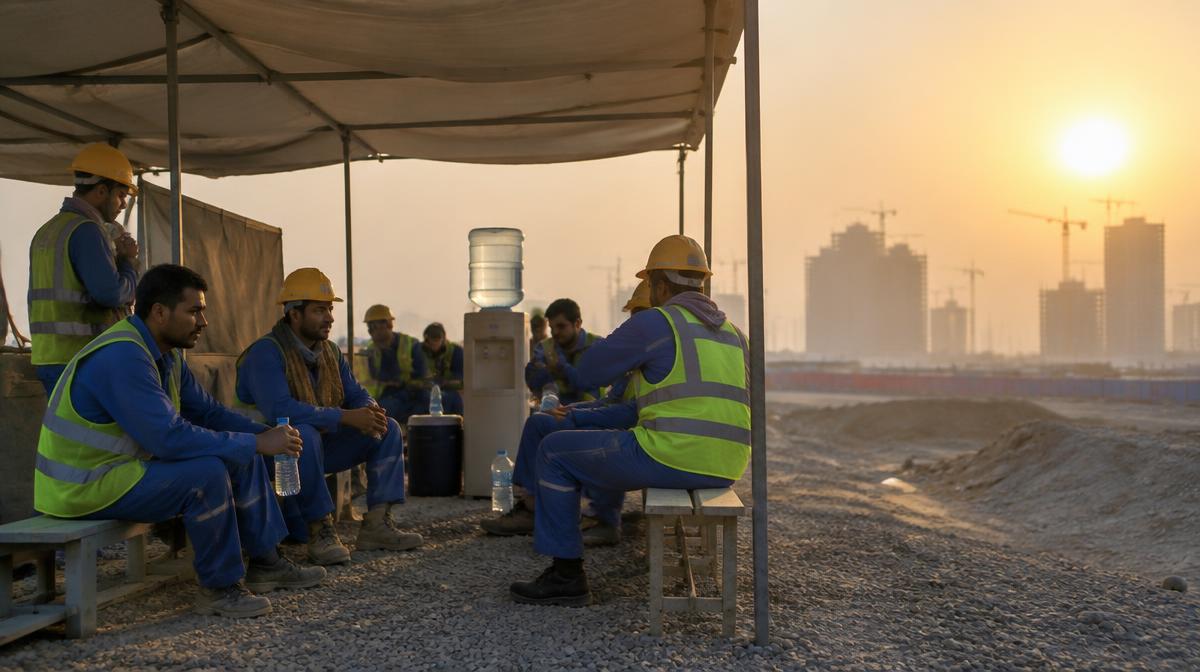
Heat is the most predictable serious risk on a UAE construction site. It arrives on a known schedule, affects every trade, and is entirely manageable with planning. It is also the risk most often managed by reminding people to drink water.
A reminder is not a control. A control is a decided work/rest pattern that the site actually follows, a rest area the crew can reach in the time the plan assumes, water within arm's reach at every workface, a supervisor watching the newest worker hardest, and a first-aid response that does not have to be invented in the moment. Those are decisions, made before the season, and they are what a season plan is.
The season plan is built in the weeks before the heat arrives, not in the week it does.
Who is most at risk, and why it is not the experienced crew
The people most likely to be seriously affected are usually not the ones who have worked Gulf summers for a decade. They are:
- New arrivals, who have not acclimatised and often do not yet know how to pace themselves or how to ask for help.
- Workers returning from extended leave, whose acclimatisation has lapsed even though their experience has not.
- People on their first weeks of a new, heavier task, whatever their experience elsewhere.
- Anyone working in the peak hours without direct supervision — including maintenance and services trades working indoors without ventilation or in plant rooms.
- People whose exposure continues after the shift — in accommodation without adequate cooling or ventilation, or travelling in an unshaded vehicle.
Acclimatisation is a physiological process that takes time, and it is lost faster than it is gained. If the plan treats all workers as equally adapted, it protects the wrong group.
What a season plan contains
Roles and triggers. One named person accountable for the season plan, and clear triggers for escalating mitigation: who decides to extend breaks, move work to night, stop a task, or provide additional cooling, and on what evidence. Where the project uses a measured heat stress index, the thresholds and actions are decided in advance and written down, so the decision on the day is not a negotiation.
Scheduling and work/rest cycles. The pattern of work and rest, defined for the conditions rather than left to the crew: earlier starts, split shifts, rotating the heaviest work out of the hottest hours, and longer or more frequent breaks as conditions worsen. The midday break requirement that applies during the UAE summer — confirm the current dates and daily hours with MOHRE for the year in question — sets a floor, not a plan: a crew that stops for the break and then works a compressed, more intense afternoon in the same heat has shifted the exposure, not removed it.
Rest and cooling provision. Rest areas that are shaded, cooled and — critically — close enough to the workface to be used. A rest area at the site gate is not a control if the round trip takes twenty minutes. The plan should assume the crew uses the nearest available shade unless something better is within reach.
Hydration provision. Water available at the workface, cool, in quantity, and accessible without leaving the task. Provision is a site responsibility, not an individual one: a workforce depending on people bringing their own bottles from the camp is a workforce that will be under-hydrated by mid-afternoon.
Work clothing and PPE interaction. Clothing choices that help rather than compound the load, and attention to tasks where protective equipment adds to heat stress — and to the reality that people remove protection when they overheat, which trades a heat risk for a different one.
Medical and first-aid response. Recognising the difference between heat exhaustion and heat stroke, and acting on it. Heat stroke is a medical emergency where cooling starts before transport is arranged — the delay spent moving someone to a vehicle instead of cooling them is the interval that decides the outcome. That requires trained first aiders on site, a clear route and response time to medical care, communication that works from every workface, and a record of every heat-related event, including minor ones and near misses.
Return to work after an event. A person who has been affected by heat is more vulnerable afterwards, and the plan should say how they return, at what intensity, and who decides.
Communication in the languages of the workforce. Briefings, toolbox talks and signage at water points in the languages the crew speaks, at the level of the newest and least experienced person on site — not the most fluent.
Monitoring that actually detects the problem
The exposure builds in the person, not on the thermometer. What works:
- Supervisors watching people, not schedules. The early signs — slowing pace, unusual quietness, flushed or pale skin, complaints of headache or nausea, someone standing apart — are visible before collapse.
- Buddy checks, especially for new arrivals and for anyone working in isolation.
- Random, visible checks at the workface, not only at the muster point, so the supervision is present where the heat is.
- A daily check that the provisions exist — water at the face, shade available, rest taken — rather than an assumption that yesterday's provision is today's.
The records worth keeping
For the season: the heat plan with the triggers and the responsible person, acclimatisation arrangements for new and returning workers, daily records of midday break compliance and the shifting actually applied, water and rest provision checks, briefing records in the relevant languages, monitoring or index records where used, first-aid events and near misses with the action taken, and any post-event return-to-work decisions.
Those records do more than satisfy a review. They are the only way to improve the next season: what actually happened, at which times, on which tasks, and to whom.
Where heat plans fail
- The plan is written in the office by someone who has never stood on the slab at 13:00 in August, and predicts a schedule the site cannot follow.
- The break is applied to some trades and not others, and the trades excluded are the ones doing the heaviest work.
- Rest areas exist, are shaded, and are never used because they are too far from the workface.
- Supervisors exempt themselves from the break, which teaches the crew that the rule is for other people.
- The camp end of the risk is ignored: accommodation cooling, ventilation, hydration and transport are as much part of heat management as the site.
- A collapse is treated as an individual's failure to drink enough, when the provision, the schedule and the supervision made it likely.
- Exposure is treated as a summer topic, when the shoulder months routinely catch people out.
Plan it once, follow it every day
Heat risk rewards preparation more than almost any other hazard, because nothing about it is a surprise. Decide the triggers, the schedule, the provision and the response before the season starts; make the provision physically real at the workface; supervise the newest workers hardest; record what happens; and review it at the end of the season while the detail is still fresh.
The site that does that has a heat plan. The site that does not has a reminder, repeated daily until something goes wrong.
"Reference material, not legal advice. Requirements differ by emirate, authority and client; confirm the current midday break rules and any authority-specific heat requirements that apply to your project."
Continue with
- Heat Stress & Midday Break Readiness Checklist (UAE) — https://sitesafetyuae.com/resources/heat-stress-summer-readiness-checklist-uae
- Heat Stress Readiness: A Field-Led Monday Check — https://sitesafetyuae.com/resources/monday-heat-stress-readiness
- Heat Stress & Welfare Operations — https://sitesafetyuae.com/solutions/heat-stress-welfare
- MOHRE Midday Break checklist — https://sitesafetyuae.com/site-checklists/mohre-midday-break
- Midday Break Planner (free tool) — https://sitesafetyuae.com/tools/midday-break-planner
- UAE Heat Stress Season Planning — https://sitesafetyuae.com/safety-trends/uae-heat-stress-season-planning
- Managing Heat Stress Compliance in the UAE — answer summary — https://sitesafetyuae.com/answers/managing-heat-stress-compliance-uae
- Ramadan Heat Stress SOP — https://sitesafetyuae.com/resources/ramadan-heat-stress-sop
Site Safety UAE builds the HSE Operations Dashboard for UAE and GCC construction projects — heat monitoring, welfare checks, briefings and compliance records in one place. Start free, no card required — https://sitesafetyuae.com/get-started.
Recommended next reads
- PPE Compliance: The Last Line Only Works When the System Behind It DoesPPE non-compliance is usually a system failure, not a worker failure. How UAE projects fix selection, fit, provision and replacement — and why the heat trade-off decides whether the equipment stays on.Read guide
- MSRA, HIRA and RAMS: What Each One Is For on a UAE SiteMSRA, HIRA and RAMS are often used interchangeably on UAE sites. Here is what each document is for, what belongs in it, and what a client HSE reviewer or authority inspector opens first.Read guide
- Scaffolding Safety in the UAE: Platform Widths, Ties, Inspection and the Alteration ProblemScaffolding is one of the most strictly regulated and most frequently altered structures on a UAE site. The platform width, guardrail gap, design trigger and inspection rules that apply, and the site practices that keep a scaffold compliant.Read guide
UAE HSE Legal Guide 2026
The consolidated PDF: federal and emirate-level HSE obligations, authority responsibilities and the evidence each inspection expects. Sent to your inbox.
Browse everything in the UAE HSE Compliance Hub.
For safety officers
Sign in to the safety officer portal for your daily reports, the hazards whose controls still need verifying, and the authority forms waiting on a decision.
See it in action
Site Safety UAE is a software-only platform. Watch the recorded demo to see the modules covering your project scope and authority mix.
Watch the demo