Article
PPE Compliance: The Last Line Only Works When the System Behind It Does
PPE non-compliance is usually a system failure, not a worker failure. How UAE projects fix selection, fit, provision and replacement — and why the heat trade-off decides whether the equipment stays on.
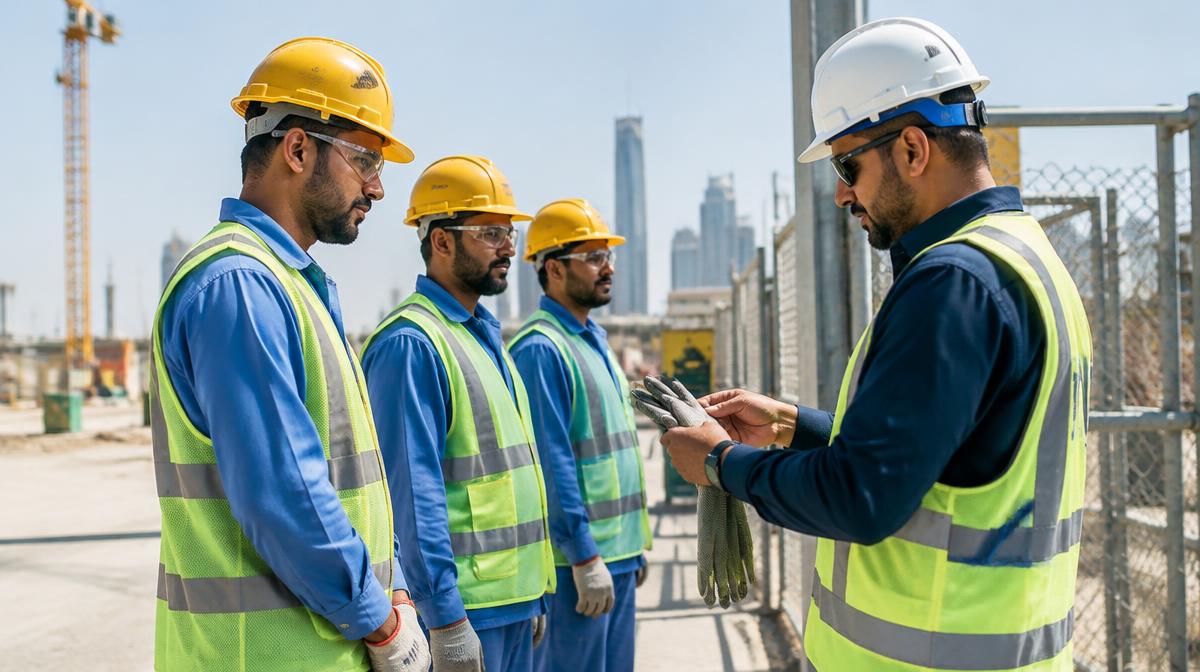
PPE is the last line of defence. It sits at the bottom of the hierarchy of control for a reason: it protects one person, it works only if it is worn correctly at the moment of the event, and it does nothing about the hazard itself. Everything above it — eliminating the task, guarding the machine, extracting the dust, protecting the edge — removes the risk rather than filtering it through a piece of equipment.
That makes the compliance question awkward but necessary. Before asking why a worker is not wearing their protection, the honest first question is whether the hazard should exist at all. PPE issued to make an uncontrolled risk tolerable is not compliance; it is a decision to manage the consequence instead of the cause.
The second question is why non-compliance happens. On most sites it is not defiance. It is a system that issued the wrong thing, in the wrong size, too slowly, and then blamed the person who took it off.
Selection: the right PPE for this hazard, not a standard kit
"Standard PPE" — helmet, glasses, gloves, boots, hi-vis — is a starting point, not an assessment. The equipment has to match the specific hazard of the specific task:
| Hazard | What selection actually means |
|---|---|
| Impact and falling objects | Head protection appropriate to the exposure, and eye protection that fits over prescription glasses |
| Dust and silica | Respiratory protection matched to the exposure, with fit testing — a disposable mask that leaks protects nobody |
| Chemical and wet work | Gloves and body protection selected for the substance, not for comfort, with the safety data sheet driving the choice |
| Noise | Hearing protection that is actually sufficient and actually comfortable enough to keep in |
| Vibration | Gloves alone do not control vibration — tool time does |
| Falls | Harness, lanyard and connectors suited to the task, the anchor and the clearance |
| Heat and sun | Clothing that balances UV protection against the heat load, and equipment that does not add to it |
The trap is the shared "site PPE" shelf that has one type of glove, one type of mask and one size of everything. Where the workforce is doing eight different tasks, one kit cannot be correct for all of them.
Fit is a control, not a preference
A poorly fitted item is a non-compliance waiting to happen, and the person who removes it is usually making a rational decision:
- Respiratory protection requires fit testing. Without it, the wearer has an assumption, not protection — and facial hair at the sealing surface makes the seal unreliable regardless of the mask. The user seal check before each use is the last step, not the only one.
- Harness fit decides the outcome of a fall. A loose harness rides up and causes injury even when the arrest works.
- Gloves in the wrong size reduce grip and dexterity, which trades one risk for another and is the fastest route to gloves being removed.
- Eye protection over prescription glasses needs a product designed for it, or the wearer will choose between seeing and complying.
- Footwear and clothing sized for the workforce, not for the average of a catalogue.
Fit testing, sizing stock and a simple exchange process are the cheapest compliance measures available, and they are usually the ones missing.
Provision: available, in date, and replaced without a fight
- Issue records that show who has what, and when it was issued — not a signature collected once at induction.
- Condition checks on the items that degrade: harnesses and lanyards, respiratory protection, chemical gloves, hearing protection, eye protection.
- Replacement that does not require a battle. If getting a replacement pair of gloves costs a worker an argument with a storeman, the site has decided that damaged gloves will be worn. Replacement has to be quick, available and not treated as an accusation.
- Storage and hygiene, particularly for shared or reusable items. Shared respiratory protection is not protection; it is an exposure route.
- Removal from service of damaged equipment, with a quarantine point so nothing returns to the shelf.
Why the PPE comes off — and what actually changes it
The reasons are consistent across projects and countries, and only one of them is about attitude:
- Heat. In the Gulf this is the dominant driver. A worker who is overheating will remove protection, and no amount of briefing overrides the body's response to heat. The answer is to address the heat — scheduling, rest, hydration, lighter clothing options, cooling — rather than to insist harder.
- Discomfort and poor fit. The item hurts, fogs, slips or restricts movement.
- Damaged or missing equipment. The replacement was not available, so the person worked without.
- Time and task pressure. The task is short, and putting it on takes longer than the task.
- The example set above them. Nothing undermines compliance faster than a supervisor, manager or visitor walking through the workface without protection, or a "just this once" exception granted to a favoured trade.
- Nobody notices either way. If the site never observes, never coaches and never follows up, PPE becomes optional in practice regardless of what the rules say.
What changes behaviour
- Visible leadership. Supervisors and managers wear the same protection as the crew, with no exceptions for rank, visitors or the short walk across site.
- Consistency. The same standard for the concrete gang, the fit-out contractor, the delivery driver and the project manager. Inconsistency teaches that the rule is negotiable.
- Make the right behaviour the easy one. Protection available at the workface, correct sizes in stock, replacement on the spot, and provision designed around the task rather than the store.
- Coach at the workface, immediately. A short, specific conversation about the hazard the person just took on — not a lecture, and not a punishment delivered two days later through a report.
- Positive reinforcement. Catching people doing it right and saying so costs nothing and works better than a compliance score.
- Escalation that is consistent and documented for the minority who ignore repeated coaching, applied to everyone equally, including subcontractors and management.
The UAE-specific interaction
Two local realities decide most PPE compliance outcomes here:
- Heat versus protection. Heavy protective clothing, full-face respiratory protection and gloves in a Gulf summer create a real physiological load. Where the provision ignores that, the site is effectively asking workers to choose between heat stress and PPE — and heat wins. Provide lighter options, adjust the schedule, and treat the equipment choice as part of heat management, not separate from it.
- Dust and silica exposure. Cutting and chasing generates exposure that a disposable mask does not control. The control is the extraction or wet method first, and fit-tested respiratory protection as the last layer — otherwise the site has issued a symbol of compliance rather than protection.
What the evidence looks like
For PPE: the assessment showing which equipment is required for which task and hazard, the issue and condition records, fit testing records for respiratory protection, harness and lanyard inspection records, training and briefing records, and the workplace observation records that show the site verifies compliance at the workface rather than assuming it.
That last item is what distinguishes a site that manages PPE from one that issues it: the records show that somebody is physically checking, in the place where the work happens, and acting on what they find.
"Reference material, not legal advice. Requirements differ by emirate, authority and client. PPE selection, fit testing and inspection must follow the requirements of the specific project and the equipment appropriate to each hazard."
Continue with
- PPE: The Last Line — Confirm It Before the Shift — https://sitesafetyuae.com/resources/monday-ppe-last-line
- PPE Issue and Condition checklist — https://sitesafetyuae.com/site-checklists/ppe-issue-condition
- PPE and Accountability (awareness module) — https://sitesafetyuae.com/training/ppe-accountability
- Respiratory Protection and Silica Dust (awareness module) — https://sitesafetyuae.com/training/respiratory-protection-silica-dust
- Heat Stress Management (awareness module) — https://sitesafetyuae.com/training/heat-stress-management
- Fall Arrest Systems — equipment inspection — https://sitesafetyuae.com/working-at-height/fall-arrest-systems
- People, Training & Subcontractors module — https://sitesafetyuae.com/modules/people
Site Safety UAE builds the HSE Operations Dashboard for UAE and GCC construction projects — PPE issue records, fit testing, observation records and training matrices in one place. Start free, no card required — https://sitesafetyuae.com/get-started.
Recommended next reads
- Heat Stress Management in the UAE: Build the Season Plan, Not the Daily ReminderHeat is the most predictable risk on a UAE site and the one most often managed by reminder instead of by plan. What a heat season plan contains — acclimatisation, work-rest cycles, provision, medical response and records.Read guide
- Occupational Health Risk on UAE Sites: The Exposures That Never Show Up in TRIRSilica, noise, welding fume, vibration and hazardous substances damage people slowly enough to stay out of accident statistics. How UAE projects assess and control occupational health exposures, and what evidence to keep.Read guide
- Dynamic Risk Assessment: What Changes Between the Signed MSRA and the WorkfaceThe MSRA was correct on Monday morning. By Wednesday the same document describes different conditions. How UAE sites re-check risk at the workface, record it, and make stop-work authority usable.Read guide
UAE HSE Legal Guide 2026
The consolidated PDF: federal and emirate-level HSE obligations, authority responsibilities and the evidence each inspection expects. Sent to your inbox.
Browse everything in the UAE HSE Compliance Hub.
For safety officers
Sign in to the safety officer portal for your daily reports, the hazards whose controls still need verifying, and the authority forms waiting on a decision.
See it in action
Site Safety UAE is a software-only platform. Watch the recorded demo to see the modules covering your project scope and authority mix.
Watch the demo