
Article
Occupational Health Risk on UAE Sites: The Exposures That Never Show Up in TRIR
Silica, noise, welding fume, vibration and hazardous substances damage people slowly enough to stay out of accident statistics. How UAE projects assess and control occupational health exposures, and what evidence to keep.
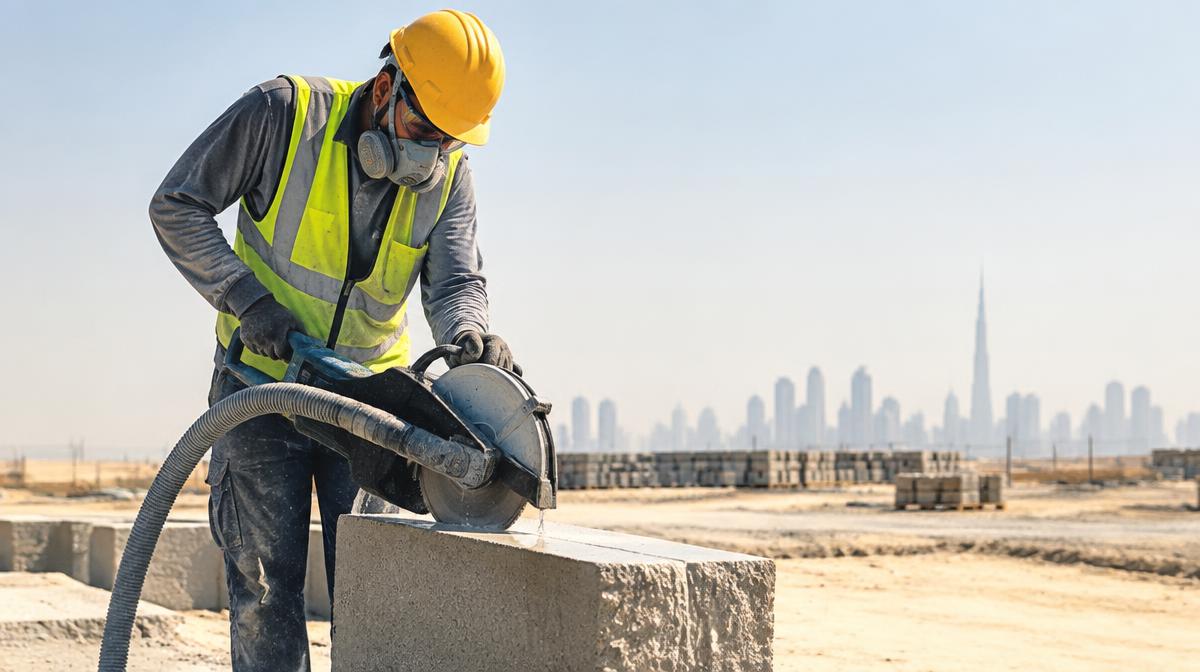
A project can finish with a strong recordable injury rate and still send a workforce home with damaged lungs, damaged hearing and damaged hands. Occupational health harm arrives over years, not shifts. It does not generate an incident report, a near miss or a corrective action, so on a busy site it stays invisible until it is irreversible.
That is the peculiar difficulty of health risk: the feedback loop that keeps people interested in safety — something went wrong, we fixed it — does not exist. Nothing went wrong today. It went wrong across eight years.
The control logic still applies. Identify the exposure, assess it, control it in the hierarchy, verify it, and keep the record. The difference is that the assessment has to be done before the work starts, because the signal that tells you it was needed arrives too late.
The main exposures on a UAE construction site
| Exposure | Typical sources | The control that actually works | Evidence it exists |
|---|---|---|---|
| Respirable crystalline silica | Cutting, grinding and chasing concrete, block and stone; breaking out; sweeping | Substitution, off-tool or on-tool extraction, wet cutting, closed cabins, exclusion of others, then RPE as the last layer | Method statement naming the cutting method, extraction unit records, RPE issue and fit test records, air monitoring where warranted |
| Noise | Cutting and chasing, piling, breaking, plant and generators, impact tools | Choice of quieter method, enclosure and distance, rotation and exposure planning, then hearing protection | Noise assessment or monitoring, mitigation plan, issue records, audiometry baseline and follow-up |
| Welding fume and metalworking | Welding, gouging, cutting, grinding | Local exhaust ventilation, extraction torches, position and screening, respiration | Extraction equipment inspection, welding controls in the MSRA, RPE records |
| Hand-arm vibration | Breakers, drills, grinders, compactors, hand-guided tools | Tool selection and low-vibration alternatives, trigger time planning and rotation, maintenance | Tool register with exposure planning, usage records, HAVS health surveillance where exposure is significant |
| Hazardous substances and chemicals | Epoxy and resin systems, sealants, solvents, form release agents, fuel and bitumen | Substitution, closed handling, ventilation, segregation and storage, spill response | Inventory with safety data sheets, COSHH-type assessment, handling controls, eyewash and washing facilities |
| Heat and cumulative load | Sustained outdoor work, night and split shifts, inadequate acclimatisation | Engineering and planning first — shading, cooling, scheduling — then work/rest cycles and hydration | Heat plan, monitoring, rest provision, records of the mitigation actually in place |
| Ergonomics and manual handling | Repetitive block laying, steel fixing, formwork handling, materials movement | Mechanised handling, layout and planning, team handling, work height control | Task assessment, equipment provision, training and supervision |
The pattern is consistent: a sensitive few, then a documented mechanism. A 15-minute exposure assessment of a block-cutting station is usually enough to establish that the dust, the noise and the handling all come from the same three decisions — the tool used, where it is used, and who stands near it.
Assess exposure, not just activity
An MSRA that says "cutting of blocks — wear PPE" has not assessed health risk. The questions that produce a real assessment are:
- What is the agent — dust, noise, fume, vibration, a chemical, heat?
- Who is exposed — the operator, the immediate helper, and the trades working downwind or alongside?
- How much and for how long — the tool, the material and the actual hours per shift?
- What is already in place — is there extraction on the tool, water suppression, a closed cab, distance, screening?
- What is the residual exposure after those controls, and is it acceptable without relying on the person wearing something?
Then record the decision. Where exposure is significant or persistent, monitoring — air sampling, noise measurement, exposure time data — converts an opinion into a number, and a number is what a health surveillance decision and a client query both rest on.
Put health in the same system as safety
Health risks drift out of the HSE system when they are treated as a separate medical topic. They belong in the same places safety risks do:
- In the HIRA, as hazards with owners and ratings, not as a wellbeing annex.
- In the MSRA, as controls on the step where the exposure is created — the cutting step, the welding step, the chasing step.
- In the permit, where the work is high-risk or confined.
- In the inspection, as conditions to verify physically: extraction connected and running, guards and screens in place, water suppression working, RPE used and stored clean, hearing protection available at the source.
- In the training matrix, with the competence that goes with the exposure — fit testing, tool use, safe systems for hazardous substances.
- In the welfare provision, because hydration, shade, washing facilities and clean rest areas are controls, not amenities.
That is what makes it hold. The supervisor who already inspects a workface for edge protection and isolation can inspect extraction and water suppression in the same walk, on the same form, in the same record.
Health surveillance: useful only if the exposure data supports it
Health surveillance is not a screen that fixes a hazard; it detects harm early enough to act. It is meaningful where a specific exposure with a known health effect is significant, and it gives a person a baseline to be compared against over time. It is close to useless as a general annual check with no exposure logic behind it.
The practical sequence on a project: assess the exposure, decide whether it is significant, define what the surveillance is for, organise the baseline before exposure begins where possible, repeat at a defined interval, and act on the results — including reviewing the controls when something changes, not just moving the person.
The same data supports the claim that the site is managing health risk rather than asserting it. Fit test records, exposure monitoring, tool registers, extraction maintenance and surveillance schedules are the health equivalent of a verified control: they show what was actually in place.
Start with the three worst on your site
Most projects do not need a new system. They need three exposures named:
- Silica from cutting. Whatever material is being cut this month, decide the method, the extraction and the exclusion, and record it on the step.
- Noise at the source. Pick the loudest sustained task on site and reduce it where it is generated — enclosure, substitution, distance — before issuing anything to wear.
- Vibration and tool time. List the high-vibration tools, plan the trigger time per person per shift, and record the rotation.
Then verify those three the way you verify edge protection — physically, at the point of work, with a name and a time — and add them to the same leading indicator you already report. Health risk stops being invisible the moment somebody is accountable for checking it.
"Reference material, not legal advice. Requirements differ by emirate, authority and client. Occupational health decisions should involve a competent occupational health professional."
Continue with
- Respiratory Protection and Silica Dust (awareness module) — https://sitesafetyuae.com/training/respiratory-protection-silica-dust
- Noise and Vibration Safety (awareness module) — https://sitesafetyuae.com/training/noise-vibration-safety
- Environment, Dust, Noise and Water checklist — https://sitesafetyuae.com/site-checklists/environment-dust-noise-water
- Hazardous Substances (COSHH) guidance — https://sitesafetyuae.com/guides/hazardous-substances-hazcom
- Hazardous Substances checklist — https://sitesafetyuae.com/site-checklists/hazardous-substances-coshh
- Heat Stress & Welfare Operations — https://sitesafetyuae.com/solutions/heat-stress-welfare
- Documents & MSRA/RAMS module — https://sitesafetyuae.com/modules/documents
Site Safety UAE builds the HSE Operations Dashboard for UAE and GCC construction projects — hazard registers, assessments, inspections, training records and audit evidence in one place. Start free, no card required — https://sitesafetyuae.com/get-started.
Recommended next reads
- Extreme Heat and Occupational Heat Stress in the UAE (2026)Summer heat remains the UAE's most widespread acute occupational-health risk. What the 15 June–15 September midday-work rule requires, and how to build WBGT-based controls that go beyond the calendar.Read guide
- Fatigue, Long Hours, Occupational Disease and Psychosocial HealthThe WHO scorecard reports that 16% of the UAE working-age population works 55+ hours per week, and eight deaths per 100,000 annually are from occupational disease vs two from injury. What management should actually change.Read guide
- PPE Compliance: The Last Line Only Works When the System Behind It DoesPPE non-compliance is usually a system failure, not a worker failure. How UAE projects fix selection, fit, provision and replacement — and why the heat trade-off decides whether the equipment stays on.Read guide
UAE HSE Legal Guide 2026
The consolidated PDF: federal and emirate-level HSE obligations, authority responsibilities and the evidence each inspection expects. Sent to your inbox.
Browse everything in the UAE HSE Compliance Hub.
For safety officers
Sign in to the safety officer portal for your daily reports, the hazards whose controls still need verifying, and the authority forms waiting on a decision.
See it in action
Site Safety UAE is a software-only platform. Watch the recorded demo to see the modules covering your project scope and authority mix.
Watch the demo