
Article
Confined Space Entry: The Rescue Arrangement Is the Part That Fails
Confined space fatalities often include someone who went in to help. How UAE sites control entry with isolation, testing and an attendant, and why the rescue arrangement — not the permit — is where entries fail.
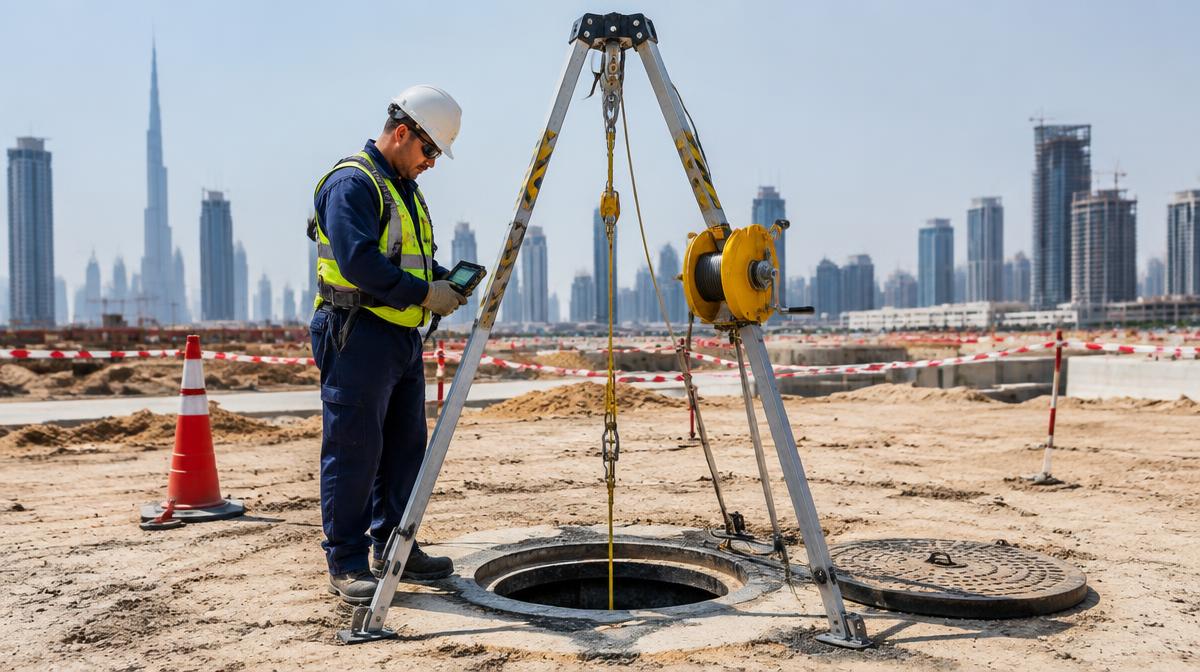
Confined space entry is unusual among high-risk activities because the permit, the testing and the briefing are usually in place, and the emergency arrangement usually is not. Sites stop at "if something happens, call civil defence" — which is not a rescue plan, it is a phone number, and it assumes a capability and a response time the site has never confirmed.
The pattern that should shape every entry decision is not only that people are overcome by the atmosphere. It is that a second and third person can die going in after the first. Confined space fatality investigations repeatedly find would-be rescuers among the dead, people entering without breathing apparatus to reach someone they can see or hear. That is why the rescue arrangement is not a supplementary attachment to the permit. It is the control that decides whether an incident kills one person or three.
First, is it even a confined space?
The classification decision is where entries most often go wrong, because the space does not have to look like a vessel to be dangerous. It is a confined space where entry and exit are limited or restricted, the space is not designed for continuous occupancy, and the atmosphere can change — which in normal construction work includes manholes and sumps, lift shafts, service ducts and trenches, basements and vaults below ground, tanks, silos, pits, wet wells, and enclosures where inert gas, exhaust, solvents, welding gases or decomposing material can accumulate.
Two practical consequences:
- Argue about classification before entry, not after. If the site is debating whether a space is confined, the answer is to control it as one until a competent person determines otherwise in writing.
- Inert or volatile work creates confined spaces. Welding, coating, solvent use, purging and diesel plant in any poorly ventilated enclosure can change the atmosphere in a way that turns a routine job into an entry.
The four questions before anyone goes in
1. Can the entry be avoided? The best entry control is not making it. Remote inspection, cameras, robotics, extending tools from the outside, or doing the work from an access platform outside the space removes the exposure entirely. Ask once, in writing, at the planning stage.
2. Is the space isolated? Every energy and material source disconnected, locked off and verified: rotating equipment, electrical supplies, hydraulic and pneumatic lines, steam, water and process lines, and any connection that could admit gas, liquid or solid into the space under any scenario, including the failure of a valve. Isolation means physical separation with a lock, not a closed valve and a message.
3. Is the atmosphere safe, and will it stay safe? Testing before entry and continuous testing while anyone is inside, for oxygen, flammability and the specific toxic gases the space can produce — not a generic reading taken once at the opening. Conditions vary with depth, with the work being done and over time: a space that was safe at 07:00 while standing empty can be unsafe at 11:00 with a running engine nearby, or with solvent vapour accumulating while someone coats a wall.
4. Can we get the person out? This is the question most sites cannot answer, and it is the subject of everything below.
Entry control that works
- A permit that names the space, the task, the entrants and the attendant — with the gas test results recorded on it and the isolation referenced.
- An attendant at the entry for the whole duration, whose only job is the entry. Not a supervisor who is also running the job, and never the person who is also inside.
- A log of who is in, who is out, at what time, and how many people are unaccounted for at any moment.
- Continuous communication with the entrants, agreed before entry, with a defined check-in interval.
- Ventilation running and monitored, not assumed: forced air that is verified as reaching the depth where the person is working.
- Correct equipment for the atmosphere: breathing apparatus where the assessment requires it, and never a dust mask or a filter cartridge in an atmosphere that may be oxygen-deficient.
- Nobody alone, ever. A single entrant with no attendant is not a managed entry.
The rescue arrangement: three layers, in order
Layer 1 — Self-rescue. The entrant recognises the problem and leaves. Only viable with a clear route, communication, and a person who is trained to leave immediately when the atmosphere changes rather than to finish the task.
Layer 2 — Non-entry rescue. A full-body harness with a retrieval line, a tripod or davit and winch at the opening, and someone who is trained to use it within seconds. This is the layer that saves the most lives, and it is the cheapest to put in place. It requires planning so the entrant is attached and the line runs without fouling the opening.
Layer 3 — Entry rescue. Trained personnel with breathing apparatus, rescue equipment and a practised plan, entering to retrieve someone who cannot be recovered from outside. This layer is either genuinely available on site, or it does not exist. A site that has not confirmed who would perform this, with what equipment and within what time, does not have a rescue plan — it has an intention.
Three questions decide whether your Layer 3 is real:
- Who is coming? A trained rescue team on the project, a contractor's team on call, or the civil defence service for the emirate. Each carries a different response time, and yours may not be the one you assumed.
- How long will they take? Establish the realistic response, then check it against how long a person can survive in the conditions the space can produce. Where those numbers do not work, the entry plan changes — or the entry does not happen.
- Has it been practised, and does the equipment exist on site? Rescue equipment inspected, present and located at the space, and a simulation or drill run for this type of space with these entrants. An untested plan is a document; a drill is evidence.
The failures that kill
- The attendant goes in. The instinct that kills two people instead of one. This is why the attendant rule is absolute, and why it has to be reinforced in every brief, not assumed.
- Testing done once, at the top, before entry. The reading that authorises the entry is not the reading that covers the work.
- Gas detection without calibration or bump testing. An instrument that has not been verified gives a number that nobody should trust.
- Ventilation assumed to be working. A fan running at the opening while the gas is still present at the working depth.
- Complacency after a hundred safe entries. A space that is "always fine" is the one where the isolation check quietly stops happening.
- Contractors entering a space nobody in the main contractor's team knew about. Sumps, temporary pits and ducts created by one trade but assumed to be controlled by another.
The evidence an entry needs to leave behind
For each entry: the confined space risk assessment, the permit with the named entrants and attendant, the gas test records with the instrument verification, the isolation records with the lock-off reference, the briefing record, the entry and exit log, the rescue plan with the confirmed rescue provider and response time, the rescue equipment inspection and any drill or simulation record, and the close-out.
Where those records exist, a site can demonstrate not only that it controlled the entry, but that it was ready for the outcome it was trying to prevent. That is the difference between a permit system and a rescue capability.
"Reference material, not legal advice. Requirements differ by emirate, authority and client. Confined space entry, testing and rescue planning must be carried out by competent persons with the appropriate equipment for the specific space."
Continue with
- Confined Space Entry: A Field-Led Entry Check — https://sitesafetyuae.com/resources/monday-confined-space-entry
- Confined Space Entry (awareness module) — https://sitesafetyuae.com/training/confined-space-entry
- Confined Space Rescue Simulation (awareness module) — https://sitesafetyuae.com/training/confined-space-rescue-simulation
- Confined Space Entry checklist — https://sitesafetyuae.com/site-checklists/confined-space-entry
- Lift Stations, Manholes & Vaults — Below-Ground Confined Assets — https://sitesafetyuae.com/solutions/below-ground-confined-assets
- Worker Extraction and Rescue Equipment (awareness module) — https://sitesafetyuae.com/training/cop46-worker-extraction-rescue-equipment
- Permits & High-Risk Work module — https://sitesafetyuae.com/modules/permits
Site Safety UAE builds the HSE Operations Dashboard for UAE and GCC construction projects — confined space permits, gas test records, entry logs and rescue plans in one place. Start free, no card required — https://sitesafetyuae.com/get-started.
Recommended next reads
- Working at Height: The Hierarchy, the Clearance Calculation and the Rescue Nobody Plans ForFalls remain among the leading causes of fatal injury on construction sites. How the hierarchy of control, the fall clearance calculation and a pre-planned rescue arrangement work together on UAE projects.Read guide
- Lifting Operations on UAE Sites: Classifying the Lift, Planning It and Controlling the ZoneHow UAE projects classify routine, non-routine and critical lifts, what a lift plan must contain, how the rigging and accessory chain is inspected, and where lifting operations most often fail.Read guide
- Confined Space Fatalities — What UAE Projects Keep Getting WrongAnalysis of confined-space near-misses and one publicly reported fatality on a UAE infrastructure project in early 2026, and the atmospheric monitoring gaps that keep appearing in investigations.Read guide
UAE HSE Legal Guide 2026
The consolidated PDF: federal and emirate-level HSE obligations, authority responsibilities and the evidence each inspection expects. Sent to your inbox.
Browse everything in the UAE HSE Compliance Hub.
For safety officers
Sign in to the safety officer portal for your daily reports, the hazards whose controls still need verifying, and the authority forms waiting on a decision.
See it in action
Site Safety UAE is a software-only platform. Watch the recorded demo to see the modules covering your project scope and authority mix.
Watch the demo