
Article
Lifting Operations on UAE Sites: Classifying the Lift, Planning It and Controlling the Zone
How UAE projects classify routine, non-routine and critical lifts, what a lift plan must contain, how the rigging and accessory chain is inspected, and where lifting operations most often fail.
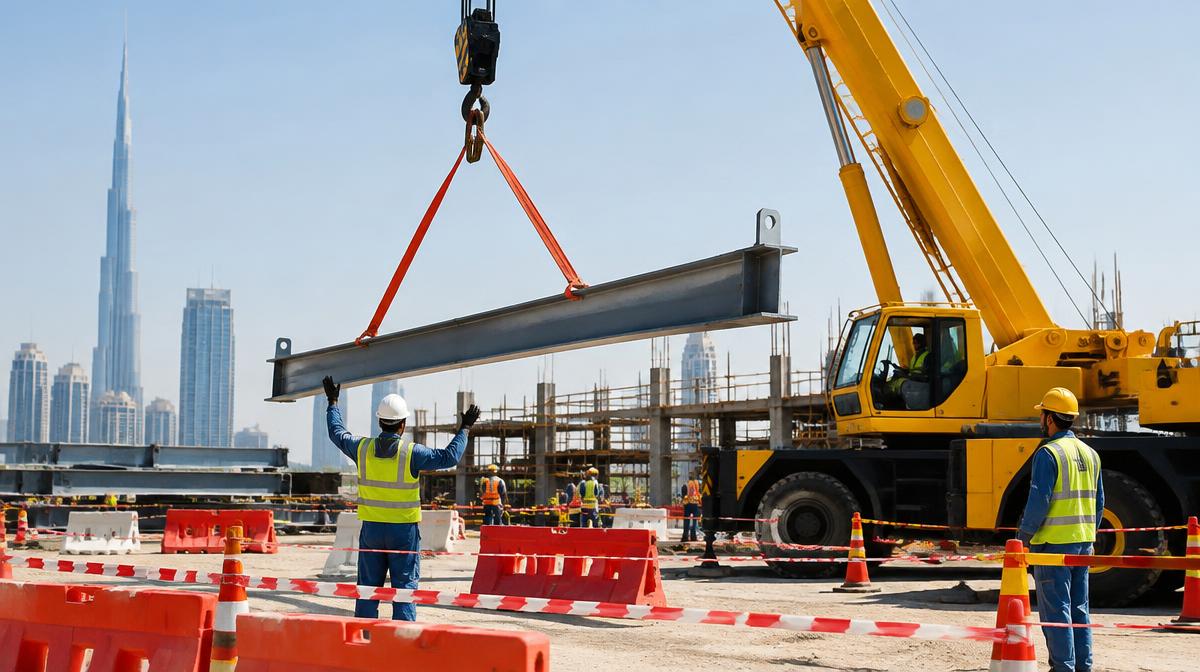
Lifting is the activity that converts an ordinary construction task into a fatal one in a single second. A sling that was fine yesterday, a load nobody weighed, an exclusion zone that was clear an hour ago, a gust that was not in the forecast — any one of them turns a routine pick into an event with no second chance.
The control that prevents it is a plan, and a plan is not a form. It is a decision about how this specific load gets from here to there with this equipment, made by people who know the load, the machine, the ground and the route, and understood by the crew at the point where the hook moves.
Classify the lift before planning it
Not every lift needs the same treatment, and treating everything as routine is how critical lifts get missed.
| Class | What it looks like | What it needs |
|---|---|---|
| Routine | Repeated, standard loads, well within capacity, known route, unaffected by the public or structure | Standard method, competent crew, pre-use checks, exclusion zone, supervision |
| Non-routine | Standard equipment or load, but not a repeated pick — isolated heavy item, unusual configuration, unfamiliar route | A written lift plan reviewed before the lift, briefed to everyone involved |
| Critical | Where the margin for error is gone — load close to capacity, tandem or multiple cranes, personnel transfer, lifting over live services, plant or the public, blind lifts, unusual attachment or a load with an unknown centre of gravity | Written plan, independent review or approval, appointed lift supervisor, and the plant and ground confirmed before the hook moves |
The classification matters because the failure mode is different. Routine lifts fail through drift — the checks stop being done because nothing has happened. Critical lifts fail through planning gaps — something about the load, the ground or the route was never established.
What a lift plan has to contain
A plan that can be briefed from, and defended after an incident, answers these without a conversation:
- The load — weight, dimensions, centre of gravity, lifting points, and the weight of the rigging itself. "Approximately" is the beginning of most lifting incidents. If the weight is unknown, it is measured or calculated before the lift.
- The capacity at the radius — not the chart's maximum, but the rated capacity at the actual working radius, boom length and configuration, with the deduction for the rigging.
- Ground and support — bearing capacity under outriggers or tracks, pad sizes, and what is underneath: basements, voids, backfilled trenches, live services, suspended slabs.
- The route and the slew path — the path of the load, the tail swing of the machine, and the clearance to structures and overhead lines.
- The roles — appointed operator, rigger or slinger, banksman or signaller, and the lift supervisor who stops it. Named, not "the crew".
- The exclusion zone — where it is, how it is physically closed, and who is allowed inside.
- Wind and weather limits — the limit for the lift, who measures it, and the stopping rule that does not require a discussion.
- Communication — the agreed signals or radio channel, and the single person giving directions.
- The contingency — what happens if the load shifts, the signal is lost, or the conditions change mid-lift.
The rigging chain is where it usually fails
Lifting accidents rarely begin with the crane. They begin with an accessory: a sling with a faded tag, a shackle from an unmarked batch, a hook latch missing, a chain block used beyond its rating, a web sling that has been in the sun for two years.
The chain that holds this together on a well-run site:
- A register. Every accessory recorded, identified and traceable, with its capacity and its certification.
- Identification that survives. Marking, colour coding or tagging that a person can read at the point of use — a code nobody can interpret is not identification.
- Certification for the equipment and the inspection interval. Third-party certification for the equipment, with periodic inspection by a competent person, and the records kept where the reviewer can find them.
- Pre-use inspection by the user. Short, physical, and honest: damage, wear, deformation, corrosion, missing latches, illegible markings. A sling that fails the check goes out of service immediately, not back on the rack.
- A quarantine point. Defective gear physically removed from circulation, tagged, and prevented from drifting back into use. Nothing reappears on site faster than a condemned sling.
- Correct use. Sling angles and the effect on capacity, protection over sharp edges, no makeshift connections, and no improvised assemblies built from whatever is in the store.
Competence is asked for by name
Operator, rigger and banksman competence is the first thing a client or authority review asks about after the plan, and it is verified by document, not by reputation. That means current licences or certificates for the machine type, third-party verification where the project requires it, and evidence that the named people on the lift are the people whose documents are on file.
The gate and the training matrix are where this is won or lost. If the crew on the hook tomorrow cannot be matched to a valid certificate in the time it takes to open a folder, the site is one review away from a stoppage.
Control the zone, not just the lift
Everything before the lift is preparation. The lift itself is controlled by the exclusion zone, and the exclusion zone works only if it is physical, closed and respected.
- Barrier the area that the load could reach if the worst happened — not the neat rectangle drawn on the plan, but the real swing radius plus margin.
- Brief the zone before the lift, and say what happens to anyone who needs to enter: the lift stops first.
- Expect the drift: deliveries, other trades, the person collecting tools. Re-check the zone, do not assume it.
- Never let a person be lifted except under a properly planned and controlled arrangement for personnel transfer — this is the highest-consequence lifting operation there is.
What a reviewer asks to see
For any lifting operation, the evidence is compact and specific: the lift plan and its review, the permit where one is required, the operator and rigger competence records, the machine's handover and periodic inspection records, the accessory certifications and the pre-use inspection records, the exclusion zone and briefing record, the wind and ground checks, and the close-out.
That set is what turns "we lift safely" into something a client, consultant or authority can verify. Where those records sit in the same system as the permits and the inspections, the answer to a lifting review takes minutes.
"Reference material, not legal advice. Requirements differ by emirate, authority and client. Crane operation, lift planning and rigging must be carried out by competent persons, and critical lifts should be reviewed by a competent lift engineer."
Continue with
- Lifting Operations: Make the Lift Plan Visible to Every Person in the Exclusion Zone — https://sitesafetyuae.com/resources/monday-lifting-operations-control
- Tower Crane Lifting Operations and TPI Evidence in Dubai — https://sitesafetyuae.com/resources/tower-crane-lifting-operations-tpi-evidence-dubai
- Lifting Slinging, Rigging and Banksman (awareness module) — https://sitesafetyuae.com/training/lifting-slinging-rigging-banksman
- Lifting Operations and Cranes checklist — https://sitesafetyuae.com/site-checklists/lifting-operations-cranes
- Tower Crane & Lifting Operations — https://sitesafetyuae.com/solutions/tower-crane-lifting
- Permits & High-Risk Work module — https://sitesafetyuae.com/modules/permits
Site Safety UAE builds the HSE Operations Dashboard for UAE and GCC construction projects — lift plans, permits, competency records and equipment inspections in one place. Start free, no card required — https://sitesafetyuae.com/get-started.
Recommended next reads
- Confined Space Entry: The Rescue Arrangement Is the Part That FailsConfined space fatalities often include someone who went in to help. How UAE sites control entry with isolation, testing and an attendant, and why the rescue arrangement — not the permit — is where entries fail.Read guide
- Buried Services and Utility Strikes: Preventing the One That Stops the JobA utility strike can injure the crew, cut power or water to a neighbourhood, and stop the project for weeks. How UAE sites control excavation near buried services with records, detection, permits and emergency arrangements.Read guide
- Dynamic Risk Assessment: What Changes Between the Signed MSRA and the WorkfaceThe MSRA was correct on Monday morning. By Wednesday the same document describes different conditions. How UAE sites re-check risk at the workface, record it, and make stop-work authority usable.Read guide
UAE HSE Legal Guide 2026
The consolidated PDF: federal and emirate-level HSE obligations, authority responsibilities and the evidence each inspection expects. Sent to your inbox.
Browse everything in the UAE HSE Compliance Hub.
For safety officers
Sign in to the safety officer portal for your daily reports, the hazards whose controls still need verifying, and the authority forms waiting on a decision.
See it in action
Site Safety UAE is a software-only platform. Watch the recorded demo to see the modules covering your project scope and authority mix.
Watch the demo