
Article
Verifying Critical Controls: The Difference Between a Control Written Down and a Control in Place
Most site risk assessments name the right controls. Very few verify them physically. How UAE projects identify critical controls, set verification frequency, record it, and report a verification rate that stands up in an audit.
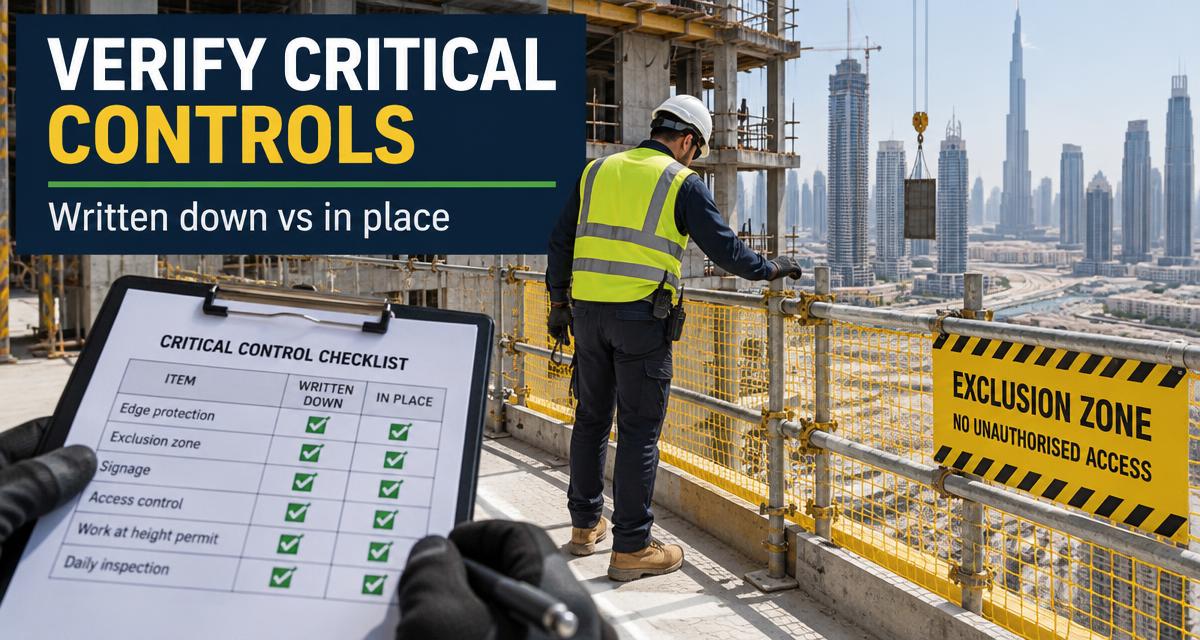
Every incident investigation on a construction site finds the same shape of gap. The risk assessment named the control. The crew had been briefed. The control was not physically in place at the moment it mattered — the barrier section was removed for access, the isolation had been broken by another trade, the exclusion zone had been walked through all week, the scaffolder had altered the lift.
Nothing was written incorrectly. Nothing was verified either. A control that is written, briefed and never checked is an intention, and intentions do not stop a fall.
What makes a control critical
A control is critical when, in its absence, the credible outcome is a fatality or irreversible harm. That definition keeps the list short and the attention concentrated. On a typical UAE construction site it includes:
| Critical control | What verification actually looks like |
|---|---|
| Edge protection and fall prevention at open edges and openings | Physical check of the barrier, fixings and gaps before the shift, and after any work that removed a section |
| Scaffold handover and status tagging | Current handover certificate, tag matching the structure, no unauthorised alteration |
| Lift plans, exclusion zones and rigging | Plan visible at the lift, barrier in place and closed, banksman and rigger identified, accessory inspection current |
| Energy isolation (LOTO) | Lock and tag applied by the person isolating, isolation roster current, no unlogged removal |
| Confined space entry controls | Gas test with a current result, attendant in position, entry log and rescue arrangement ready |
| Plant and pedestrian segregation | Barriers and crossing points physically intact on the live route, not on the drawing |
| Excavation support, access and edge protection | Supports and access as designed, edges protected, plant set-back maintained |
| Temporary electrical supply and RCD protection | Protection device present and testable, distribution secure and closed |
| Hot work fire watch | Watch in position with equipment, extended beyond the last spark, area checked again afterwards |
If your site's critical control list is longer than a page, it is not a critical control list — it is the whole inspection schedule. Cut it to the controls that stand between the site and a fatality.
Verification means physical, at the workface, with a record
Three tests separate verification from an inspection that looks like one:
- It is physical. Someone stood at the control and confirmed it with their own eyes, not from a photograph, a report or a radio exchange.
- It is at the point of work. The barrier at the edge the crew is working behind, not the barrier at the site entrance.
- It is recorded. Name, time, location, control, result, and what happened next if the result was a fail.
An inspection that logs "housekeeping — satisfactory" across twenty categories does not verify anything. A single line reading "level 6 slab edge, north-west corner, barrier complete to 1.2 m, no gaps, verified 06:40, A. Kumar" does.
Set the frequency to the exposure
Verify each control at the cadence its exposure demands, not at the cadence of the reporting calendar:
- Before each task where the control is installed and removed repeatedly — edge protection around an active opening, fire watch, exclusion zones.
- At the start of every shift where the control is inherited — scaffold status, isolations carried across a shift change, temporary electrical supplies.
- Weekly and after any alteration where the control is structural — temporary works, excavation support, traffic routes.
- On activity for isolated systems — every isolation and de-isolation logged against the permit it belongs to.
The frequency belongs in the risk assessment entry, next to the control, with a named owner. Send it nowhere else.
Report the rate, not just the findings
Most sites report inspection findings: how many defects, how many closed out. Fewer report the number that matters more — what proportion of critical controls were verified when they were due to be verified.
Verification rate is a leading indicator with a direct relationship to risk: it moves before the incidents do, it is cheap to collect once the record exists, and it is meaningful to a client, a consultant or an authority because it describes the strength of the site's assurance rather than the absence of events.
A practical monthly pack line:
- critical controls on the register: 12
- verifications due this month: 340
- verifications completed and recorded: 331 — 97%
- failed verifications raised as actions: 19, of which 17 closed, 2 open with owners and dates
- controls under 90% verification this month: hot work fire watch — cause and corrective action
That table answers the question your client's HSE manager and every auditor eventually asks: how do you know the controls you rely on are actually in place?
Make it work this week
Do not start with a system. Start with six controls:
- Write down the six critical controls for your current phase — the ones where absence means a fatality.
- For each, define one verification frequency and one person accountable.
- Give supervisors a single field form with four fields: control, location, result, action and owner.
- Verify one of the six yourself today, physically, and record it the same way you expect from them.
- Add one line to the weekly report: verifications due, completed, failed, closed, and any control under 90%.
- When a control fails verification, restore it and record the restoration. Failures that are found and fixed are the system working, not the site failing.
Where those records live in the same place as the permit, the assessment and the inspection history, the evidence exists before anyone asks for it. That is the practical difference between a site that can prove control and one that can only describe it.
"Reference material, not legal advice. Requirements differ by emirate, authority and client."
Continue with
- HSE KPIs & Reporting module — https://sitesafetyuae.com/modules/reporting — leading indicators, TRIR and management review packs
- Inspections & Incidents module — https://sitesafetyuae.com/modules/inspections — configurable checklists, defects, near misses and observations
- Construction HSE KPI Dashboard: Leading Indicators for UAE Projects — https://sitesafetyuae.com/resources/construction-hse-kpi-dashboard-leading-indicators-uae
- Trakhees HSE Audit Preparation (2026) — https://sitesafetyuae.com/resources/trakhees-hse-audit-preparation-2026
- Dubai Municipality HSE Audit Preparation — https://sitesafetyuae.com/resources/dubai-municipality-hse-audit-preparation
Site Safety UAE builds the HSE Operations Dashboard for UAE and GCC construction projects — inspections, control verification, permits and audit evidence in one place. Start free, no card required — https://sitesafetyuae.com/get-started.
Recommended next reads
- The 5×5 Risk Matrix on UAE Sites: Why the Scores Drift and How to Calibrate ThemThe same hazard gets a 4×4 on one MSRA and a 2×3 on another in the same week. How to define likelihood and severity bands, calibrate scoring across a UAE project, and make residual ratings mean something.Read guide
- Near-Miss Reporting That Actually Produces ActionsCounting near misses is easy. Turning them into owned, dated corrective actions is what reduces risk. A practical flow for UAE construction sites.Read guide
- Construction HSE KPI Dashboard: Leading Indicators for UAE ContractorsThe leading and lagging indicators worth reporting on a UAE construction HSE dashboard — inspection completion, close-out ageing, training coverage, near-miss rate, TRIR and LTIFR — with formulas and review cadence.Read guide
UAE HSE Legal Guide 2026
The consolidated PDF: federal and emirate-level HSE obligations, authority responsibilities and the evidence each inspection expects. Sent to your inbox.
Browse everything in the UAE HSE Compliance Hub.
For safety officers
Sign in to the safety officer portal for your daily reports, the hazards whose controls still need verifying, and the authority forms waiting on a decision.
See it in action
Site Safety UAE is a software-only platform. Watch the recorded demo to see the modules covering your project scope and authority mix.
Watch the demo