
Article
Fire Risk on a Live Construction Site: Fire Load, Escape Routes and Impairment
A building under construction is a fire risk no finished-building assessment describes: open shafts, temporary supplies, stored materials and no compartmentation. How UAE sites assess and control fire risk through the build.
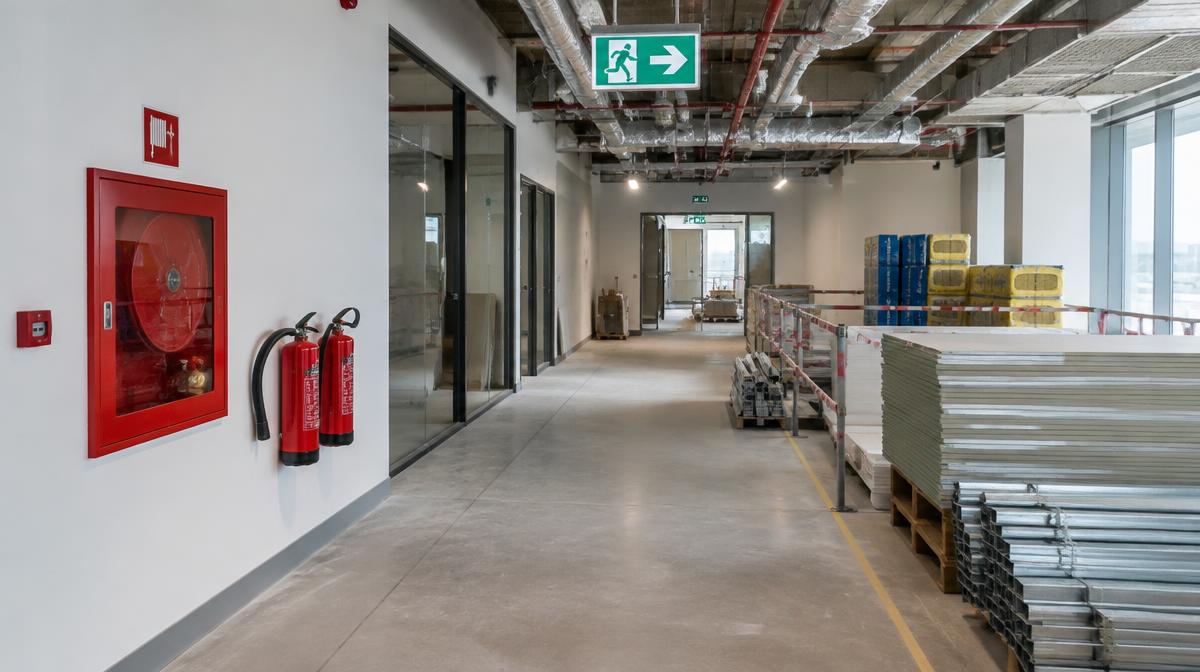
A fire risk assessment written for a completed building describes a structure with compartmentation, protected escape routes, a working detection and suppression system and a known occupancy. A building under construction has none of those yet — and usually has far more combustible material inside it than it will ever hold when it is finished.
That inversion is the core of construction fire risk. The protection is at its weakest exactly when the fuel load is at its highest, the temporary electrical supply is at its most improvised, and the people inside the structure know the building less well than they ever will again.
It is also the fire risk most often assumed rather than assessed, because everyone believes the hot work permit is the whole of it.
Where construction fire risk actually comes from
| Source | Why it is worse during construction |
|---|---|
| Accumulated combustible material | Packaging, pallets, formwork timber, insulation, plastics and stored materials sit inside a structure with open vertical shafts and incomplete compartmentation |
| Temporary electrical installations | Distribution boards, trailing leads, adaptors and temporary lighting, often added to by multiple trades and rarely re-inspected as the load grows |
| Hot work | The most common ignition source on site, and the one with an existing control regime — which is why it is usually over-credited |
| Flammable liquids and gases | Fuel storage and refuelling, LPG, solvents, adhesives, form release agents and coatings |
| Waste and housekeeping | Mixed waste stored against the structure, in stair cores and against facades, close to ignition sources and escape routes |
| Open shafts, atria and facade openings | Vertical fire spread with nothing to stop it, and smoke filling the routes people need to leave by |
| Incomplete escape provision | Temporary stairs, unlit routes, changing layouts, and access blocked by trades working in them |
| Impairment of installed systems | A system installed early and switched off, isolated or incomplete, with nobody tracking the resulting gap |
Assess it before the phases that create it
A construction fire risk assessment is not one document written at mobilisation. It follows the build, because the risk moves:
- Below ground and frame stages — timber and formwork concentration, temporary supplies, hot work, poor egress from deep structures, vertical spread through cores.
- Fit-out and services — the highest risk period. Combustible materials everywhere, many trades in the same space, temporary power at its most extended, and permanent protection still incomplete.
- Handover transition — the awkward overlap where the permanent systems are being commissioned and trades are still finishing, and responsibility for fire safety is genuinely ambiguous.
Write the assessment for the phase you are in, and note in it what changes at the next one.
Controls that hold up in practice
Control the fuel. Segregate and limit combustible storage by area, keep it out of shafts and stair cores, and treat waste removal as a fire control rather than a tidiness topic. Daily clear-out of the work area is one of the cheapest fire controls available.
Control the ignition. Hot work permits, fire watch during and after the task, area preparation and clearance, and gas cylinder handling and storage discipline. Existing site practice covers the permit; the post-task check and the watch that outlasts the last spark are where it usually thins out.
Protect the routes. Keep escape routes defined, lit and clear through every phase change, including routes that a trade wants to use for storage or access for one shift. Travelling distance and the direction of travel change as the structure grows — brief them again.
Plan the response before you need it. Muster points that are still valid when the layout changes, access for civil defence appliances that is not blocked by a delivery, a fire point system that stays in place as the work moves, and a means of raising the alarm that works from the far side of a large structure.
Manage impairment explicitly. When a system, supply, route or piece of equipment is out of service — even for a few hours — record the impairment, the compensatory measures, who was notified and when it was restored. This is the discipline most sites apply to permanent buildings and least often apply to their own temporary conditions.
Drill in the phase you are in. A drill run from a clear ground-floor layout proves little about evacuating a slab at level 12 with a stair core full of materials. Run the drill where the people actually are.
The hot work trap
Hot work is the ignition source with the strongest existing controls, and that is exactly why it gets over-credited in construction fire risk: because it is permitted, briefed and inspected, it feels covered. The fires that do significant damage usually involve something else — a temporary distribution board, an overloaded lead, discarded smoking material, a flammable liquid stored near a source of heat, or waste that accumulated and nobody owned.
Set the site's fire controls so that no single failure starts a serious fire: fuel limited and separated, ignition controlled and watched, detection and alarm available or a fire watch performing that function, escape routes protected, and a response that everyone can execute from where they work.
What to keep as evidence
For each phase: the current fire risk assessment with the layout it applies to, the hot work permit and fire watch records, housekeeping and waste removal records, fire point and extinguisher inspections, impairment records with compensatory measures, drill records with the participating crews and the phases tested, and the briefings given when routes or layouts changed.
Taken together, those records show a project that managed fire risk through the build rather than one that assumed a finished building's protection covered a site in progress.
"Reference material, not legal advice. Fire safety requirements differ by emirate, authority and building type; civil defence and authority requirements for the specific project govern."
Continue with
- Hot Work: The Fire-Watch Check That Must Outlast the Last Spark — https://sitesafetyuae.com/resources/monday-hot-work-fire-watch
- Emergency Response Drills: Cadence and Evidence for Dubai Civil Defence Compliance — https://sitesafetyuae.com/resources/emergency-response-drills-dcd-expectations-uae-sites
- Civil Defence Fire Precautions checklist — https://sitesafetyuae.com/site-checklists/civil-defence-fire-precautions
- Fire Prevention and Hot Work checklist — https://sitesafetyuae.com/site-checklists/fire-prevention-hot-work
- Fuel Storage and Refuelling checklist — https://sitesafetyuae.com/site-checklists/fuel-storage-refuelling
- Hygiene & Fire Assurance — https://sitesafetyuae.com/hygiene-fire-assurance
Site Safety UAE builds the HSE Operations Dashboard for UAE and GCC construction projects — permits, inspections, drill records and audit evidence in one place. Start free, no card required — https://sitesafetyuae.com/get-started.
Recommended next reads
- Permit to Work at Shift Handover: Where Controls Quietly DisappearA permit that was safe at 06:00 is not automatically safe at 14:00. How to hand over open permits, isolations and exclusion zones so the controls survive the change of crew.Read guide
- Contractor Interface Risk: When Two Safe Methods MeetEach contractor's method statement can be sound and the combination still dangerous. How to find and control interface risks before crews overlap.Read guide
- Dynamic Risk Assessment: What Changes Between the Signed MSRA and the WorkfaceThe MSRA was correct on Monday morning. By Wednesday the same document describes different conditions. How UAE sites re-check risk at the workface, record it, and make stop-work authority usable.Read guide
UAE HSE Legal Guide 2026
The consolidated PDF: federal and emirate-level HSE obligations, authority responsibilities and the evidence each inspection expects. Sent to your inbox.
Browse everything in the UAE HSE Compliance Hub.
For safety officers
Sign in to the safety officer portal for your daily reports, the hazards whose controls still need verifying, and the authority forms waiting on a decision.
See it in action
Site Safety UAE is a software-only platform. Watch the recorded demo to see the modules covering your project scope and authority mix.
Watch the demo