Article
Sharjah’s OSHJ Announcement: Our Review of the 6 October 2026 Update
What Sharjah’s OSHJ announcement means for construction and accommodation safety, with verified technical-code references and clear limits on unconfirmed legal details.
Our review of Sharjah’s 6 October 2026 announcement examines what employers and construction teams should check now, which controls already appear in the published OSHJ technical codes, and which detailed legal claims still need confirmation against the Arabic decision. This is Site Safety UAE’s editorial review, published on 9 November 2026, not an authority announcement or an official translation.
The Executive Council announcement, corroborated by WAM and Sharjah24, confirms a decision concerning the Sharjah Occupational Safety and Health System (OSHJ). It describes coverage of government entities, private establishments, employers and workers in Sharjah; protection at workplaces and accommodation; Sharjah Police’s powers; employer and worker duties; and administrative violations and penalties. The news reports do not reproduce the detailed provisions. [1] [9] [10]
Verification limit: the supplied draft identifies Decision No. 54 of 2026 and cites its Arabic instrument [2]. That government-hosted PDF was reachable, but its Arabic text could not be reliably extracted for this review. We have not independently confirmed its decision number, repeal of Decision 15 of 2021, commencement clause, article numbering, duty counts, fine schedules, escalation rules or grievance deadlines. Those details are not presented below as established law. Obtain a controlled copy and a competent Arabic legal review before changing a legal register or acting on an enforcement notice.
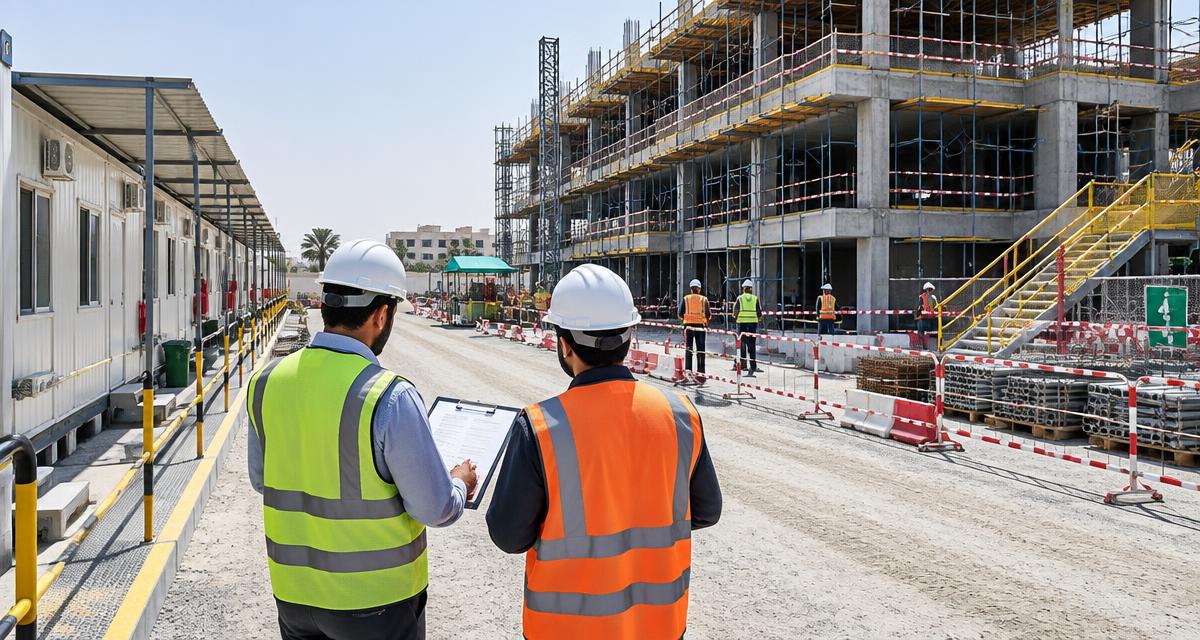
Illustrative image: AI-generated construction scene, not a photograph of a named Sharjah project or an inspected workplace.
What changed in the October announcement?
The verified announcement brings attention to workplace and accommodation safety, responsibilities and enforcement under OSHJ. It is not evidence that occupational safety regulation began in Sharjah in October 2026. The archived official 2021 general guideline provides historical context; the linked construction, accommodation and incident codes carry May 2026 issue dates. Their controls therefore appear in documents dated before the announcement. [3] [5] [6] [7]
The supplied draft describes a replacement decision rather than a limited amendment. Until the Arabic repeal and commencement provisions are independently confirmed, treat that description as a point for legal-register review, not proof that the older instrument has been repealed or that every obligation took effect on 6 October. An announcement date, issue date, commencement date and technical-code revision date are different facts.
Accommodation belongs in the HSE assurance process
The announcement expressly discusses protection at workers’ workplaces and accommodation. The published OSHJ-CoP-25 is titled Occupational Safety and Health in Workers Accommodation, Issue 3, May 2026. Its existence before October means accommodation safety should not be described as a wholly new concern introduced by this announcement. [1] [6]
The practical effect is that accommodation cannot be excluded from the employer’s HSE assurance process simply because a facilities team or an external provider operates the building. The linked OSHJ-CoP-25, Issue 3, May 2026, covers employer-supplied accommodation owned or managed by the employer or a contracted third party within its stated scope. It addresses pre-occupancy assessment, at least an annual risk-assessment review, emergency arrangements, fire protection, first aid, sanitation, ventilation, and well-being (Sections 2–5) [6]
Section 5.2.1 of the accommodation code requires emergency response plans to be tested periodically, at a minimum annually. Section 5.2.2 requires monthly inspections to confirm that firefighting systems and equipment are adequately maintained. The annual emergency-plan test, annual fire risk-assessment review and monthly equipment inspection are different checks; one signed fire plan does not replace them. These are technical-code provisions in the May 2026 document, not new deadlines announced on 6 October. [6]
Accommodation duty and penalties: the draft’s Article 5(13) interpretation and its three accommodation fine amounts have not been independently confirmed against readable Arabic legal text. Do not infer from this article that every employer must house every worker, or that a particular fine automatically applies. Check the decision, contract, code scope and authority directions for the actual arrangement.
Contractors, clients and consultants need demonstrable control
The linked OSHJ-CoP-02, OSH Management in Construction, identifies itself as Issue 4, May 2026. It is a technical source to review alongside the decision and the project’s appointments. Do not assume that the October announcement makes every pre-existing construction control new. [5]
On a construction project, this affects procurement and mobilization as much as routine inspections. The main contractor needs an effective way to verify subcontractor status, competence, and resources, and to check that the approved work method and controls are being followed. A permit or method statement is evidence of planning; it is not proof that the workface is controlled.
For a project management consultancy, our practical recommendation is to review evidence against the applicable OSHJ requirements and the consultancy’s actual appointment. Confirm that deficiencies have owners, deadlines and verified closure. Delegating site activities is not a substitute for checking the responsibilities attached to each appointment. These are assurance recommendations, not a claim that Site Safety UAE can approve a contractor or transfer legal responsibility.
Contractor legal provisions: the draft’s Article 5(5), contractor-registration fine entries and January 2025 responsibility-change comparison have not all been independently verified in this review. Check the original decision, controlled code and amendment record before treating those specific descriptions as legal conclusions.
Competence must reach the workface
A first-aid certificate in a personnel file is therefore insufficient if that person is absent from the night shift. Similarly, an HSE job title is not evidence that the classification-dependent appointment and approval requirements have been met.
Our practical review questions are straightforward: is competent first-aid cover available on the shifts actually worked; are any classification-dependent OSH appointments evidenced; and can workers understand the information, instructions and emergency arrangements? Check what the applicable authority documents require rather than relying solely on attendance signatures, job titles or a certificate filed at head office.
Staffing and language clauses: the draft’s Article 5(14), Article 5(16), sign-language requirements and associated AED 10,000 penalty entries require confirmation against the Arabic decision. The practical checks here do not establish a universal staffing ratio, approval entitlement or fine.
Read enforcement details from the instrument, not a headline
The official announcement confirms that the decision addresses administrative violations and penalties. It does not give the amounts, first-occurrence warning conditions, recurrence calculation, suspension triggers or grievance procedure. Those cannot safely be reconstructed from the news report alone. [1] [9] [10]
Unconfirmed enforcement detail: the supplied draft describes 31 employer and 10 worker violations; a two-month first-occurrence warning; AED 2,000–10,000 second-occurrence amounts; doubling within one Gregorian year; high-risk exceptions; suspension, closure and licence measures; and a 15-working-day grievance window with an AED 100 fee. We have not independently verified those details. They are listed here only to identify what needs legal checking, not as an applicable penalty guide.
For business leaders, this makes timely, evidence-based rectification a continuity issue. A fine payment is not the same as correcting the breach, and an internal “closed” status is not proof that the unsafe condition has been removed.
Preserve any notice, the date it was received, the authority’s instructions and supporting evidence immediately. Obtain case-specific advice on the actual deadline and available procedure. Do not assume an objection, a payment or an internal close-out status permits unsafe work to continue.
Incident reporting is separate from internal notification
The linked OSHJ-CoP-17, Incident Reporting and Investigation, identifies itself as Issue 3, May 2026. Section 5.1.1 requires fatality reporting within 24 hours from the person being pronounced dead. Section 5.1.2 and the reporting table identify specified injuries, occupational diseases and dangerous occurrences for reporting within 72 hours. Check the reportable categories and their stated triggers; not every internal incident record is the same authority-reporting event. [7]
Section 5.3 requires submission of the investigation report through the online system within the timeframe in Table 2. The table gives a 30-day investigation-report submission timeframe for its listed incident categories, and the text requires prior approval where submission within the required timeframe will not be possible. Review the complete table for the incident concerned rather than treating 30 days as a universal deadline for every internal investigation. These provisions appear in the May 2026 code and are not new deadlines created by the October announcement. [7]
Emergency response, internal notification, authority reporting and subsequent investigation are separate steps. A subcontractor’s email to the main contractor or a report sent to the client should not be assumed to satisfy authority notification. Check the code’s reporting line and any other relevant authority requirements. Keep a record of the actual submission, not just the intention to report.
What should employers and construction teams do now?
- Obtain and review the controlled Arabic decision and schedules; verify its number, commencement, repeal provisions and applicable directions before updating the legal register.
- Check OSHJ registration, risk classification, appointments and contractor evidence against the requirements applicable to the entity and project.
- Include employer-managed and contracted accommodation within the assurance review where the code applies.
- Check actual shift coverage, worker comprehension, emergency arrangements and evidence of field controls.
- Separate authority notification from internal incident reporting and investigation; confirm the relevant category, trigger and submission deadline.
- Assign owners and deadlines to corrective actions, and verify the unsafe condition has actually been removed.
Much of the work good HSE teams already do remains relevant: current requirements, applied controls and evidence of follow-through. The October announcement is a reason to review the framework, not a reason to claim that every control, penalty or accommodation duty is new. Our recommendations support that review; they do not constitute regulatory approval.
Current public technical documents can be accessed through the Sharjah Police OSHJ library [4]. The issue dates above are those printed in the linked PDFs, not inferred from upload dates, and do not by themselves establish that no later version exists. For an enforcement case, review the published Arabic decision, schedules and applicable implementing directions. This article is not an official translation or a substitute for case-specific legal advice.
Official sources and verification notes
Reviewed on 9 November 2026. The announcement and three linked technical-code PDFs were checked independently. The Arabic decision was reachable but not reliably text-readable; its detailed interpretation remains explicitly unconfirmed. The archived 2021 document is historical context only. The supplied draft’s Q3 inspection and injury-reduction statistics are omitted because they were not independently verified for this review and, in any event, would not demonstrate an effect of the October decision.
- Sharjah Executive Council announcement: decision regarding OSHJ, 6 October 2026
- Unconfirmed source
Government-hosted PDF reachable; Arabic legal provisions, decision-number attribution, repeal, commencement and penalty interpretation not independently confirmed from reliable readable text.
- Archived official OSHJ General Guideline, Version 1 Rev 0: reproduces Decisions 15 and 26 of 2021; historical comparison only
- Sharjah Police: official OSHJ Codes of Practice and Guidelines library
- OSHJ-CoP-02: OSH Management in Construction, Issue 4, May 2026
- OSHJ-CoP-25: Occupational Safety and Health in Workers Accommodation, Issue 3, May 2026
- OSHJ-CoP-17: Incident Reporting and Investigation, Issue 3, May 2026
- WAM: Sharjah Executive issues decision regarding OSHJ, 6 October 2026
- Sharjah24: Executive Council meeting and OSHJ decision, 6 October 2026
Recommended next reads
- UAE Authority Updates: Construction Review Beyond Dubai’s 2026 Safety GuideReviewed Dubai registration laws, Qudorat, ADOSH CoPs, Sharjah and RAK editions, with official links and clearly marked utility and free-zone evidence gaps.Read guide
- When Did Your Company Last Research and Update Its Safety Files?Why UAE HSE files need a quarterly authority review: DDA, Trakhees, RAKEZ, ADOSH-SF, Sharjah and DHCA updates, and five checks to follow changes through to site.Read guide
- UAE Authority Safety Circulars and Regulations 2024–2026DDA circulars, Trakhees forklift rules, DHCA fit-out, Qudorat, Sharjah accommodation, RAKEZ fines and MoHRE amendments, with official links and verification labels.Read guide
UAE HSE Legal Guide 2026
The consolidated PDF: federal and emirate-level HSE obligations, authority responsibilities and the evidence each inspection expects. Sent to your inbox.
Browse everything in the UAE HSE Compliance Hub.
For safety officers
Sign in to the safety officer portal for your daily reports, the hazards whose controls still need verifying, and the authority forms waiting on a decision.
See it in action
Site Safety UAE is a software-only platform. Watch the recorded demo to see the modules covering your project scope and authority mix.
Watch the demo